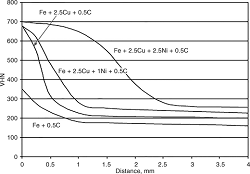
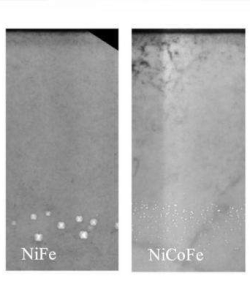
Nickel increases tensile properties of as-sintered powder metallurgy steels approximately one-half as much as copper but provides significantly higher strength after heat treatment. This is because of the heterogeneous nature of nickel-alloy steels made of blended elemental powders.
Copper melts at 1083°C (1981.4°F) and forms a liquid phase on sintering at 1120°C (2050°F), creating a more homogeneous iron-copper alloy. Nickel has a higher melting point than the sintering temperature, and it alloys by solid-state diffusion. This produces a duplex microstructure consisting of partially alloyed iron surrounding nickel-rich islands. On quenching, the matrix transforms to martensite, but the nickel-rich areas remain austenitic. This combination results in a stronger matrix with some toughness and ductility retained.
For more information, click on the link below (subscription required). Then scroll to Figure 14.
Joseph W. Newkirk, Heat Treatment of Powder Metallurgy Steels, Heat Treating of Irons and Steels, Vol 4D, ASM Handbook, Edited By Jon L. Dossett, George E. Totten, ASM International, 2014, p 253-273, https://doi.org/10.31399/asm.hb.v04d.9781627081689.