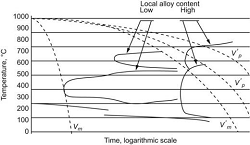
With the variety of local chemical compositions present after sintering, different microstructures form on cooling unless completely prealloyed powders are used. The degree of local composition variation can be significant, so it is better to look at the concept of critical cooling speed in terms of these local variations.
The figure shows the conditions of maximum and minimum hardenability, with the following results assuming that some carbon is present. Only pearlitic structures are formed when cooling speeds are lower than Vp. V′p is the critical speed necessary to form only pearlite in the regions richest in alloying elements.
The structure becomes completely martensitic on cooling when cooling speeds are higher than Vm. Likewise, V′m is the critical speed necessary to form only martensite in the regions richest in alloying elements.
Cooling speeds typically used in industrial practice after sintering are generally between V′p and Vm. This situation occurs when materials based on admixed and diffusion-bonded powders containing Ni and Mo are used.
For more information, click on the link below (subscription required). Then scroll to Figure 22.
Joseph W. Newkirk, Heat Treatment of Powder Metallurgy Steels, Heat Treating of Irons and Steels, Vol 4D, ASM Handbook, Edited By Jon L. Dossett, George E. Totten, ASM International, 2014, p 253-273, https://doi.org/10.31399/asm.hb.v04d.9781627081689