Far below the ground lies a sphere of solid iron and nickel about as wide as the broadest part of Texas: the Earth’s inner core. The metal at the inner core is under pressure about 360 million times higher than we experience in our everyday lives and temperatures approximately as hot as the Sun’s surface.
Earth’s planetary core is thankfully intact. But in space, similar cores can collide with other objects, causing the crystalline materials of the core to deform rapidly. Some asteroids in our solar system are massive iron objects that scientists suspect are the remnants of planetary cores after catastrophic impacts.
Measuring what happens during the collision of celestial bodies or at the Earth’s core is obviously not very practical. As such, much of our understanding of planetary cores is based on experimental studies of metals at less extreme temperatures and pressures. But researchers at the Department of Energy’s SLAC National Accelerator Laboratory have now observed for the first time how iron’s atomic structure deforms to accommodate the stress from the pressures and temperatures that occur just outside of the inner core.
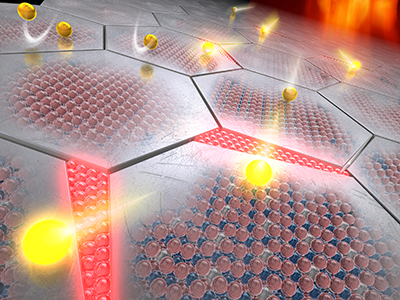
Most of the iron you encounter in your everyday life has its atoms arranged in nanoscopic cubes, with an iron atom at each corner and one in the center. If you squeeze these cubes by applying extremely high pressures, they rearrange into hexagonal prisms, which allow the atoms to pack in more tightly.
The group at SLAC wanted to see what would happen if you kept applying pressure to that hexagonal arrangement to mimic what happens to iron at the Earth’s core or during atmospheric reentry from space.
No one had ever directly observed iron’s response to stress under such high temperatures and pressures before, so the researchers didn’t know how it would respond.
“As we continue to push it, the iron doesn’t know what to do with this extra stress,” says co-author Arianna Gleason, a scientist in the High-Energy Density Science (HEDS) Division at SLAC. “And it needs to relieve that stress, so it tries to find the most efficient mechanism to do that.”
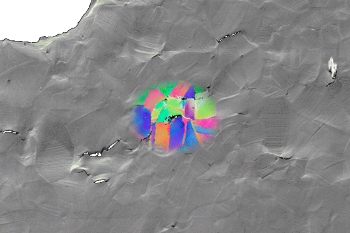
The coping mechanism iron uses to deal with that extra stress is called twinning. The arrangement of atoms shunts to the side, rotating all the hexagonal prisms by nearly 90 degrees. Twinning is a common pressure response in metals and minerals — quartz, calcite, titanium, and zirconium all undergo twinning.
The results appear in Physical Review Letters, where they have been highlighted as an Editor’s Suggestion.
For more information: Physical Review Letters