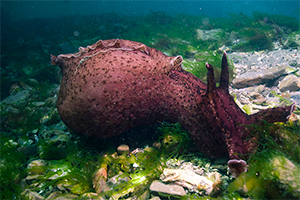
A new study has found that a material can mimic the sea slug’s most essential intelligence features. The discovery is a step toward building hardware that could help make AI more efficient and reliable for technology ranging from self-driving cars and surgical robots to social media algorithms.
“Through studying sea slugs, neuroscientists discovered the hallmarks of intelligence that are fundamental to any organism’s survival,” said Shriram Ramanathan, a Purdue professor of materials engineering. “We want to take advantage of that mature intelligence in animals to accelerate the development of AI.”
Two main signs of intelligence that neuroscientists have learned from sea slugs are habituation and sensitization. Habituation is getting used to a stimulus over time, such as tuning out noises when driving the same route to work every day. Sensitization is the opposite – it’s reacting strongly to a new stimulus, like avoiding bad food from a restaurant.
AI has a really hard time learning and storing new information without overwriting information it has already learned and stored, a problem that researchers studying brain-inspired computing call the “stability-plasticity dilemma.” Habituation would allow AI to “forget” unneeded information (achieving more stability) while sensitization could help with retaining new and important information (enabling plasticity).
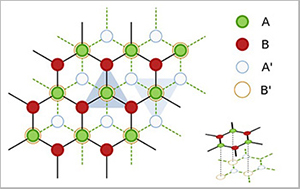
In this study, the researchers found a way to demonstrate both habituation and sensitization in nickel oxide, a quantum material. The material is called “quantum” because its properties can’t be explained by classical physics.
If a quantum material could reliably mimic these forms of learning, then it may be possible to build AI directly into hardware. And if AI could operate both through hardware and software, it might be able to perform more complex tasks using less energy.
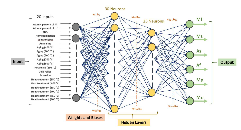
Inspired by these findings, a research group under Kaushik Roy, Purdue’s Edward G. Tiedemann Jr. Distinguished Professor of Electrical and Computer Engineering, modeled nickel oxide’s behavior and built an algorithm that successfully used these habituation and sensitization strategies to categorize data points into clusters.
This study is a starting place for guiding those next steps, the researchers said. In addition to the experiments performed at Purdue, a team at Rutgers University performed detailed theory calculations to understand what was happening within nickel oxide at a microscopic level to mimic the sea slug’s intelligence features. Argonne National Laboratory characterized the nickel oxide sample’s properties and the University of Georgia measured conductivity to further analyze the material’s behavior.
For more information: Purdue University