Researchers have known about high-temperature superconducting copper-based materials, or cuprates, since 1980. Below a certain temperature (approximately -130 degrees Celsius), electrical resistance vanishes from these materials and magnetic flux fields are expelled. However, the basis for that superconductivity continues to be debated and explored.
“It has been widely accepted that traditional superconductors result from electrons interacting with phonons, where the phonons pair two electrons as an entity and the latter can run in a material without resistance,” said Yao Wang, assistant professor of physics and astronomy at Clemson University.
However, in cuprates, strong repulsions known as the Coulomb force were found between electrons and were believed to be the cause of this special and high-temperature superconductivity.
Phonons are the vibrational energy that arise from oscillating atoms within a crystal. The behavior and dynamics of phonons are very different from those of electrons and putting these two interacting pieces of the puzzle together has been a challenge.
In November 2021, writing in the journal Physical Review Letters, Wang, along with researchers from Stanford University, presented compelling evidence that phonons are in fact contributing to a key feature observed in cuprates, which may indicate their indispensable contribution to superconductivity.
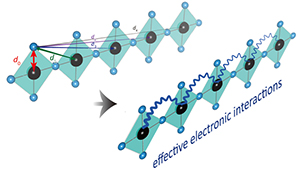
The study innovatively accounted for the forces of both electrons and phonons together. They showed that phonons impact not only electrons in their immediate vicinity, but act on electrons several neighbors away.
“An important discovery in this work is that electron-phonon coupling generates non-local attractive interactions between neighboring electrons in space,” Wang said. When they used only local coupling, they calculated an attractive force an order of magnitude smaller than the experimental results. “This tells us that the longer-range part is dominant and extends up to four-unit cells,” or neighboring electrons.
The demonstration of phonon-mediated attraction has a significant impact even beyond the scope of superconductors. “Practically, the results mean we’ve found a way to manipulate Coulomb interactions,” Wang said, referring to the attraction or repulsion of particles or objects because of their electric charge.
“If superconductivity comes from Coulomb forces only, we cannot easily manipulate this parameter,” he said. “But if part of the reason comes from the phonon, then we can do something, for instance, putting the sample on some substrate that will change the electron-phonon interaction. That gives us a direction to design a better superconductor.”
Wang and collaborator Cheng-Chien Chen, from the University of Alabama, Birmingham, also applied this new approach and powerful TACC supercomputers to study laser-induced superconductivity. They reported these findings in Physical Review X in November 2021. And working with a team from Harvard, Wang used TACC supercomputers to study the formation of Wigner crystals in work published in Nature in June 2021.
For more information: Physical Review X