Various masking techniques have been developed to protect components next to the coating area from impact by overspray particles. These methods include:
- Shadow masks
- High-temperature tapes, most commonly two-sided, silicone tape to resist blasting and spray, 3M stencil tape for blasting and spray resistance, and glass-filled tape for both blasting and spraying
- Paint-on masking compounds
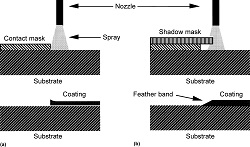
Metal shadow masks are placed approximately two to three times the total coating thickness away from the part to be sprayed and in front of the spray torch, shielding selected areas from the direct spray stream.
The targeted spray area may be stationary or rotating. The mask is typically stationary and securely affixed. As the spray stream is traversed across the target area and onto the mask, the unwanted spray collects on the mask and is prevented from reaching the substrate. The coating will end in a narrow feathered band rather than as a sharply defined line (Fig. 10b).
In contrast to the feathered edge, note that a contact mask (Fig. 10a), similar to tape, leaves a sharp edge, which may act as a stress raiser that often leads to disbonding of the coating. Metal masks can be reused, subject to the amount of coating buildup and/or distortion due to heat from the spray process.
Sheet metal masks are preferred for HVOF spraying because tapes do not stand up to high-velocity particle impact and the high thermal output of the gun.
Tape masks are applied by hand wrapping areas that do not require a coating. After spraying, the tape is easily removed, along with accumulated overspray, leaving the protected areas clean. Many different tapes are available commercially, some for resistance to grit blasting and others for thermal spraying. The best tapes for the job have sufficient toughness to resist both grit blasting and heat resistance to withstand hot process gases and particle impact during spraying. The coating line when the tape is removed after the application of thin coatings leaves a neat and clean edge, but if the coating is thick, chipping is likely to result where bridging over the tape has occurred.
Image – Figure 10: Coatings resulting from (a) contact masks versus (b) shadow masks
This information is from ASM Handbooks Online, Vol. 5A: Thermal Spray Technology, Coating Structures, Properties, and Materials. To find this information (subscription required), click on the link below and scroll down to Figure 10.
https://dl.asminternational.org/handbooks/book/12/chapter/134972/Introduction-to-Coating-Design-and-Processing