Powder metallurgy parts are case hardened to obtain higher hardness, wear, fatigue, and impact properties. The primary purpose of case hardening low-carbon steels is to provide a hard, wear-resistant surface while maintaining a soft ductile core. This combination imparts optimum wear resistance and toughness properties to these material
When porosity levels are such that there is significant open porosity, pores are interconnected by small channels, which allows gases to penetrate with little hindrance. When case hardening PM parts using gases containing a high carbon potential, the interconnected porosity enables diffusion of carbon into the internal pore surfaces and into the external surfaces of the part. This can result in carburization to a significant depth and consequent loss of any sharply defined case-hardening effect. The same applies to other gaseous surface-hardening procedures such as nitriding and carbonitriding. In fact, swelling that occurs during nitriding is very detrimental if it occurs internally due to open porosity.
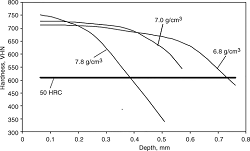
The figure shows the effect of density on the case depth during vacuum carburizing of an iron-copper alloy. Lower densities produce much higher case depth. The line for 50 HRC indicates the effective case .
For more information, click on the link below (subscription required). Then scroll to Figure 28.
Joseph W. Newkirk, Heat Treatment of Powder Metallurgy Steels, Heat Treating of Irons and Steels, Vol 4D, ASM Handbook, Edited By Jon L. Dossett, George E. Totten, ASM International, 2014, p 253-273, https://doi.org/10.31399/asm.hb.v04d.9781627081689