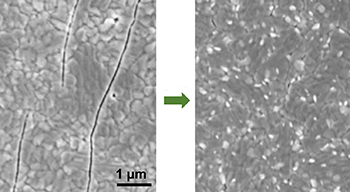
A cracked perovskite film (left) can be fully healed (right) with some compression of a little heat, new research shows. The findings from a new study bode well for the long-term reliability of perovskite films used in next-generation solar cells.
The study, published in the journal Acta Materialia, finds that though perovskite films tend to crack easily, those cracks are easily healed with some compression or a little bit of heat. That bodes well, the researchers say, for the use of inexpensive perovskites to replace or complement pricy silicon in solar cell technologies.
“The efficiency of perovskite solar cells has grown very quickly and now rivals silicon in laboratory cells,” said Nitin Padture, the Otis E. Randall Professor in Brown’s School of Engineering and director of Brown’s Institute for Molecular and Nanoscale Innovation. “Everybody’s chasing high efficiency, which is important, but we also need to be thinking about things like long-term durability and mechanical reliability if we’re going to bring this solar cell technology to the market. That’s what this research was about.”
Perovskites, a broad class of crystalline materials, were first incorporated into solar cells in 2009. Those first perovskite solar cells had a power conversion efficiency of around 4%, but now that exceeds 25%—essentially the same as traditional silicon. The advantage of perovskite solar cells is that they can be made for a fraction of the cost of silicon, potentially cutting the cost of solar power installations. Perovskites can also be made into thin films that are semi-transparent and flexible, potentially clearing the way for energy-generating windows or for lightweight, flexible solar cells in tents or backpacks.
For the study, Srinivas Yadavalli, a doctoral student working in Padture’s laboratory and the first author of the paper, deposited perovskite films on plastic substrates. He then bent the substrate to put tensile (pulling apart) stress on the perovskite film while using a scanning electron microscope (SEM) to detect cracks. Once the film was cracked, the researchers then bent the substrate in the opposite direction to see if compressive stress might heal those cracks.
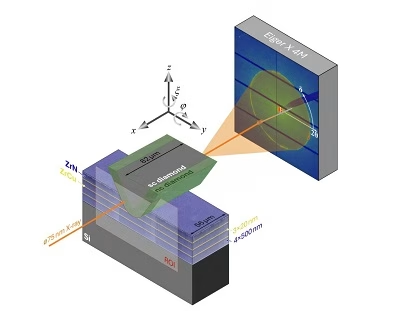
Sure enough, SEM imaging showed that the cracks had disappeared. To make sure the cracks were fully healed and not merely hidden, the researchers used a technique known as x-ray diffraction. By measuring the size of a material’s atomic lattice, the technique can reveal whether a formerly cracked area is now able to carry a mechanical load—a surefire sign that the crack is healed. Those tests also indicated fully healed cracks.
The researchers found that heat was just as effective in healing cracks. Temperatures around 100 degrees Celsius—quite modest heating by material science standards—were enough to completely heal cracks in perovskite films.
Image – A cracked perovskite film (left) can be fully healed (right) with some compression of a little heat, new research shows. The findings bode well for the long-term reliability of perovskite films used in next-generation solar cells. Courtesy of Padture Lab/Brown University.
************
For more information: