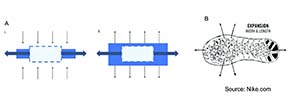
When you stretch a material, it normally becomes thinner. Take the case of a rubber elastic band. Most materials behave like this. Yet, a small number of materials can become thicker when they are stretched. An example is the tendons that connect muscle to bone. These materials are known as ‘auxetics’, from the Greek auxetos, meaning ‘that which may be increased’.
This behavior is found in several naturally occurring materials such as ceramics (e.g. natrolite and alpha-cristobalite), metals (e.g. arsenic and cadmium) and biological systems (e.g. cat skin, salamander skin and cow teat skin) among others. It is also possible to manufacture certain auxetic materials including foams and yarns.
While not common, this behavior is especially interesting since the resulting materials have unique and superior mechanical properties. For example, they can bend into a dome-shaped structure and show enhanced mechanical properties such as increased indentation, hardness, and shear modulus. These properties have made it possible for auxetics to be studied for use in applications such as personal protective equipment (helmets, bulletproof vests, and knee pads).
Auxeticity mainly depends on the internal geometry a material has and the way this geometry deforms when stress is applied. Thus, a macro or microstructure material may exhibit conventional behavior or auxetic behavior, depending on how the microstructure is arranged. For example, it is possible to find both conventional and auxetic polyurethane foam.
To date, man-made auxetic materials whose behavior is due to the geometry and its deformation at a molecular scale do not exist, although numerous systems have been proposed. Such artificial materials would find applications in specialized fields such as the production of some auxetic biomedical devices.
In this regard, a team of researchers from the University of Malta are looking into possible ways of producing an auxetic material for biomedical applications by using computer simulations followed by experimental work. Furthermore, they are designing these materials to include antimicrobial groups, with the aim of producing new auxetic materials with antimicrobial properties to be incorporated into biomedical devices such as catheters. These newly designed materials would lead the way to reduced hospital-induced infections and more comfort for the patient.
For more information: University of Malta