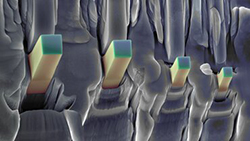
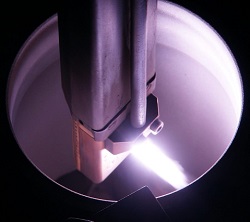
On the micrometer scale, deformation properties of metals change profoundly due to the complex intermittent redistribution of lattice dislocations caused by external loading. This results in the formation of the uneven step-like surface upon deformation. To study this phenomenon, research groups of the Eötvös Loránd University of Budapest, Charles University of Prague and École des Mines de Saint-Étienne have developed a highly sensitive micromechanical platform, where weak elastic waves emitted by the specimen can be detected during the deformation of micron-scale pillars.
Compression experiments performed on such zinc single crystalline micropillars in a scanning electron microscope confirmed that these so-called acoustic signals indeed occur during strain bursts, so, this experiment allowed us, for the first time, to practically hear the “sound of dislocations.”
The acoustic signals are sampled with a rate of 2.5 MHz; therefore, they provide extremely detailed information on the dynamics of dislocations. The in-depth statistical analyses performed by the researchers revealed that strain bursts exhibit a two-level structure. What has so far been seen as a single plastic slip is, in fact, a result of several correlated events on a μs-ms timescale.
The most surprising outcome of the experiments is that this process, despite the fundamental differences between deformation mechanisms of metals and that of tectonic plates, was found to be completely analogous to earthquakes.
Acoustic signals emitted from the testpieces followed fundamental empirical laws established for main shocks and aftershocks in seismology, such as the Gutenberg-Richter and Omori laws.
“These results are expected to bear high technological impact since, for the first time, we were able to observe direct connection between acoustic signals and the plastic events that emitted them,” said Péter Dusán Ispánovity, assistant professor at Eövös Loránd University and head of the Micromechanics and Multiscale Modelling Research Group. “Since the measurement of acoustic emission is a frequent method for monitoring and locating material failure in technological applications, by providing fundamentally new information about the underlying physics our results are expected to contribute to the further development of this technique.”
The methodology can also be used to investigate other types of deformation mechanisms, such as twinning or fracture, so the results, which were published in Nature Communications, are expected to open up new vistas in the research of micromechanical properties of materials.
Image – On the micrometer scale deformation properties of metals change profoundly. The smooth and continuous behavior of bulk materials often becomes jerky due to random strain bursts of various sizes. Courtesy of Péter Dusán Ispánovity and Dávid Ugi.
************
For more information: