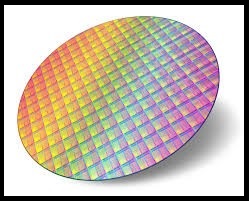
A team at the Research Institute for Electronic Science at Hokkaido University, Japan, has synthesized a barium cobalt oxide thermoelectric converter that is reproducibly stable and efficient at temperatures as high as 600°C, opening new avenues towards the widespread use of thermoelectric converters.
Waste heat is a very promising source of energy conservation and reuse, by means of converting this heat into electricity—a process called thermoelectric conversion. Commercially available thermoelectric conversion devices are synthesized using rare metals. While these are quite efficient, they are expensive and, in the majority of cases, utilize toxic materials. Both these factors have led to these converters being of limited use. Alternatives are oxide-based thermoelectric materials, but their primary drawback is a lack of evidence of stability at high temperatures.
Thermoelectric conversion is driven by the Seebeck effect: a temperature difference across a conducting material generates an electric current. However, the efficiency of thermoelectric conversion is dependent on a figure called the thermoelectric figure of merit ZT. Historically, oxide-based converters had a low ZT, but recent research has revealed many candidates that have high ZT, but their stability at high temperatures was not well documented.
Hiromichi Ohta’s group has been working on layered cobalt oxide films for over two decades. In this study, the team sought to examine the thermal and chemical stability of these films, as well as measure their ZT values, at high temperatures. They tested cobalt oxide films layered with sodium, calcium, strontium or barium, analyzing their structure, resistivity, and thermal conductivity.
They found that, of the four variants, the barium cobalt oxide layered film retained its stability in terms of structural integrity and electrical resistivity at temperatures as high as 600°C. In comparison, the sodium- and calcium cobalt oxide films were only stable until 350°C, and the strontium cobalt oxide film was stable up to 450°C. The ZT of the barium cobalt oxide film increased with the temperature, reaching ~0.55 at 600°C, comparable to some commercially available thermoelectric converters.
“Our study has shown that barium cobalt oxide films would be excellent candidates for high-temperature thermoelectric conversion devices,” said Hiromichi Ohta. “In addition, they are environment friendly, giving potential for wide deployment.”
Their findings were published in the journal ACS Applied Materials & Interfaces.
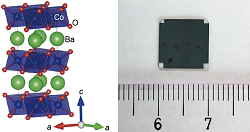
Image – Crystal structure of the barium cobalt oxide film (left; Courtesy of: Xi Zhang, Yuqiao Zhang, et al. ACS Applied Materials & Interfaces. July 12, 2022), and the metal oxide film itself (right; Courtesy of: Hiromichi Ohta).
For more information:
Research Institute for Electronic Science – Hokkaido University
https://www.es.hokudai.ac.jp/english/