Scientists at the University of Chicago have now begun to announce the first results from the analysis of an extraordinary handful of dirt collected from the surface of a speeding asteroid by a spacecraft called Hayabusa2, which came back to Earth in 2020 in the Australian outback, after a six-year journey. When researchers from the Japanese space agency JAXA opened it, what they found suggests that this asteroid is a piece of the same material that coalesced into our sun four-and-a-half billion years ago.
“We previously only had a handful of these rocks to study, and all of them were meteorites that fell to Earth and were stored in museums for decades to centuries, which changed their compositions,” said geochemist Nicolas Dauphas, one of the three University of Chicago researchers who worked with a Japan-led international team of scientists to analyze the fragments.
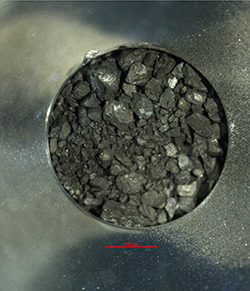
In 2018, Hayabusa2 landed atop a moving asteroid named Ryugu and collected particles from above and below its surface. After spending a year and a half orbiting the asteroid, it returned to Earth with a sealed capsule containing about five grams of dust and rock. Scientists around the world have been eagerly anticipating the unique sample—one that could help redefine our understanding of how planets evolve and how our solar system formed.
Scientists are particularly excited because these particles would never have reached Earth without the protective barrier of a spacecraft.
“Usually, all we get to study of asteroids is the pieces that are big enough to make it to the ground as meteorites,” said UChicago geochemist Andrew M. Davis, another member of the analysis team. “If you took this handful and dropped it in the atmosphere, it would burn up. You would lose it, and a lot of evidence about the history of this asteroid would go with it. We really haven’t had a sample like this before. It’s spectacular.”
The first compilation of the researchers’ results, reported in Science on June 9, reveal the makeup of Ryugu.
The rock is similar to a class of meteorites known as “Ivuna-type carbonaceous chondrites.” These rocks have a similar chemical composition to what we measure from the sun and are thought to date back to the very beginnings of the solar system approximately four-and-a-half billion years ago—before the formation of the sun, the moon and Earth.
Back then, all that existed was a gigantic, rotating cloud of gas. Scientists think that most of that gas was pulled into the center and formed the star we know as the sun. As the remnants of that gas expanded into a disk and cooled, it transformed into rocks, which still float around the solar system today; it appears Ryugu may be one of them.
The scientists noted that a percentage of the find will be set aside so that we can analyze them in the future with more advanced technology—much as we did with lunar samples from Apollo.
This mission is the first of several international missions that will bring back samples from another asteroid named Bennu, as well as unexplored areas on our moon, Mars, and Mars’ moon Phobos. This should all be taking place in the next 10 to 20 years.
Image – A photograph of the rocks retrieved by Hayabusa2 from the asteroid Ryugu.
************
For more information: