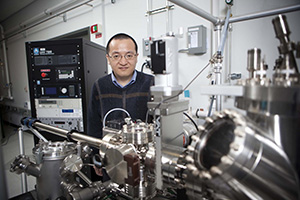
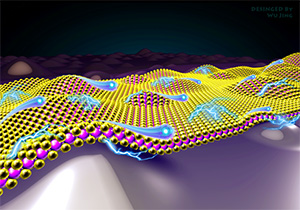
A new study in the journal Nature, led by Professor Guangwen Zhou from the Thomas J. Watson College of Engineering and Applied Science’s Department of Mechanical Engineering and the Materials Science program at Binghamton University, uses transmission electron microscopy (TEM) to peer into the oxide-to-metal transformation at the atomic level. Of particular interest are the mismatch dislocations that are ever-present at the interfaces in multiphase materials and play a key role in dictating structural and functional properties.
Using the advanced technique, Zhou said, “manufacturers may be able to control the microstructure and properties of current materials and design new types of materials. There is some practical importance for this research, but there’s a fundamental significance as well.”
The experiments tested the transformation of copper oxide to copper. Directly observing such an interface transformation at the atomic scale is challenging because it requires a capability not only to access the buried interface but also to apply chemical and thermal stimuli to drive the transformation.
By using environmental TEM techniques capable of introducing hydrogen gas into the microscope to drive the oxide reduction while simultaneously performing TEM imaging, the research team was able to atomically monitor the interfacial reaction. Surprisingly, the researchers observed that the transformation from copper oxide to copper occurs in an intermittent manner because it is temporarily stopped by mismatch dislocations, a behavior similar to a stop-and-go process regulated by traffic lights.
“This is unexpected, because the common sense accepted by the materials research community is that interface dislocations are the locations to facilitate the transformation rather than to delay it. This looping, iterative process between experiments and computer modeling, both at the atomic level, is an exciting aspect for materials research,” Zhou said.
The fundamental information could prove useful in designing new types of multiphase materials and controlling their microstructure, which can be used in diverse applications such as load-bearing structural materials, electronic fabrication and catalytic reactions for clean energy production and environmental sustainability.
For more information: Binghamton University State University of New York