A University of Michigan-led team of engineers and software developers developed a new beta version of tomviz, an open-source 3D data visualization tool software that connects directly to an electron microscope, enabling researchers to see and manipulate 3D visualizations of nanomaterials in real time, and is already used by tens of thousands of researchers.
The new version reinvents the visualization process, making it possible to go from microscope samples to 3D visualizations in minutes instead of days. Thanks to 3D visualization, computer chip designers, materials scientists, biologists and other scientists now have an unprecedented level of access to the world of nanoscale materials.
In addition to generating results more quickly, the new capabilities enable researchers to see and manipulate 3D visualizations during ongoing experiments. That could dramatically speed research in fields like microprocessors, electric vehicle batteries, lightweight materials and many others.
“It has been a longstanding dream of the semiconductor industry, for example, to be able to do tomography in a day, and here we’ve cut it to less than an hour,” said Robert Hovden, an assistant professor of materials science and engineering at U-M and corresponding author on the paper, published in Nature Communications. “You can start interpreting and doing science before you’re even done with an experiment.”
The new software pulls data directly from an electron microscope as it’s created and displays results immediately, a fundamental change from previous versions of tomviz. In the past, researchers gathered data from the electron microscope, which takes hundreds of two-dimensional projection images of a nanomaterial from several different angles.
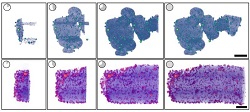
Next, they took the projections back to the lab to interpret and prepare them before feeding them to tomviz, which would take several hours to generate a 3D visualization of an object. The entire process took days to a week, and a problem with one step of the process often meant starting over. The new version of tomviz does all the interpretation and processing on the spot. Researchers get a shadowy but useful 3D render within a few minutes, which gradually improves into a detailed visualization.
The sheer speed of the new process could also be useful in industry—semiconductor chip makers, for example, could use tomography to run tests on new chip designs, looking for failures in three-dimensional nanoscale circuitry far too small to see. In the past, the tomography process was too slow to run the hundreds of tests required in a commercial facility, but Hovden believes tomviz could change that.
Tomviz can be run on a standard consumer-grade laptop, and it can connect to newer or older models of electron microscopes. And because it’s open-source, the software itself is accessible to everyone.
To develop the new capabilities, the UM team drew on its longstanding partnership with software developer Kitware and also brought on a team of scientists who work at the intersection of data science, materials science and microscopy. At the start of the process, Hovden worked with Kitware and Brookhaven National Laboratory to hone the idea of a version of tomviz that would enable real-time visualization and experimentation. Next, Hovden and Kitware’s developers collaborated with Argonne National Laboratory researchers to build algorithms that could quickly and accurately turn electron microscopy images into 3D visualizations. He also worked with professors and staff scientists at Cornell and Berkeley Lab’s Molecular Foundry to design a user interface that would support the new capabilities.
For real-world testing of the new capabilities, UM researchers synthesized a nanoparticle to both ensure accuracy and show off their capabilities. They settled on a nanoparticle shaped like a helix, about 100 nanometers wide and 500 nanometers long. The new version of tomviz worked as planned; within minutes, it generated an image that was shadowy but detailed enough for the researchers to make out key details like the way the nanoparticle twists, known as chirality. About 30 minutes later, the shadows resolved into a detailed, three-dimensional visualization.
Hovden believes it will open new possibilities to fields beyond materials-related research; fields like biology are also poised to benefit from access to real-time electron tomography. He also hopes the project’s “software as science” approach will spur new innovation across the fields of science and software development.
The source code for the new beta version of tomviz is freely available for download at GitHub.
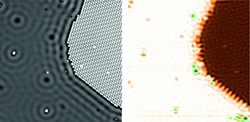
Image – This rendering of platinum nanoparticles on a carbon support shows how tomviz interprets microscopy data as it’s created, resolving from a shadowy image to a detailed rendering. Credit: Jonathan Schwartz et al, Nature Communications (2022).
For more information:
Github
https://github.com/OpenChemistry/tomviz/releases/tag/2.0.0-rc1
University of Michigan