Metalysis, U.K., developed new complex metal powder alloys that offer significant material characteristics for the latest aerospace applications. Metalysis uses an electrolysis process to reduce metal oxides into metal powders, binary through to multi-component complex alloys and intermetallics. Through its patented technology Metalysis can create complex new alloy powders unable to be produced using traditional methods. These materials offer many advantages for diverse applications in industry, especially for additive manufacturing (AM).
The metal oxide is reduced into a metal powder while removing the oxygen using an electrolyte of calcium chloride, which is environmentally benign and commonly used to de-ice roads. The Metalysis process does not require the melting of oxides and so is significantly less energy intensive than traditional methods, enabling the ability to alloy elements with widely divergent physical properties – e.g., metals with a 2336°C difference in melting points. The process is applicable across 49 elements of the periodic table, so Metalysis can produce alloys and the next generation of complex or high entropy alloys – where traditional methods struggle or are economically prohibitive.
A high entropy alloy (HEA) is a new type of alloy – by convention consisting of five metals – which have in the past proven extremely difficult to produce given that metals have such different physical properties which make them difficult to alloy together.
Traditional alloys consist of one or two major component metals with smaller amounts of other elements – an HEA consists of equal proportions of its constituent metals which are diffused equally throughout the new alloy. Combining metals in this way means a new generation of consistent alloys can be created, which can provide improved heat resistance, strength, fatigue-resistance, corrosion-resistance and fracture-resistance at elevated temperatures – ideal for aerospace applications.
Ian Mellor, managing director at Metalysis says they have created an aluminium-scandium (Al-Sc) master alloy with 36% scandium weighting, an alloy that traditional manufacturers struggle to produce. The 36% weighting scandium results in a more consistent material whilst allowing the end-user additional flexibility regarding the scandium level present in the final product as it can be reduced down from 36% which means reduced transportation costs as essentially large weightings of aluminium are not being shipped around the world.
Metalysis has worked with partners to create an aluminium-scandium sputtering (metal depositing) target for use in the production of 5G networks and AI. Chips used in 5G and AI are dusted by the sputtering target. These Al-Sc coated chips are highly resilient and maintain their functionality when compared to traditional materials.
For aerospace, this aluminium-scandium master alloy is targeted for its lightweighting and structural properties. In relation to achieving net-zero, it can be employed in heat exchangers/radiators, condensers and anywhere heat removal is needed, as well as in fuel cell manifolds.
Al-Sc diluted to less than 2% also has application in aircraft airframes, wings and engines, giving a 10% energy saving, where a 0.7% Sc loading gives 20% reduction in jet weight. There is growing demand for >2% Al-Sc for use in UAVs and drones as it provides lightweighting for speed and resilience.
Once a powder has been produced, it undergoes further processing. The output is lightly crushed or milled, then washed. There are no hazardous chemicals used, just washing in water or dilute acid. Metalysis powders can be spherodised, and we are finding there is interest in metal alloys that can be used via powder metallurgy routes, such as HIP or AM processes.
The benefit of the Metalysis process for AM is that during electrolysis the particle shape and size can be controlled, meaning near 100% of the required powder can be produced in a given range. There is much interest in metal grade powders for Al-Sc sputtering targets or indeed tantalum powders for sputtering targets which are used in the production of semiconductors.
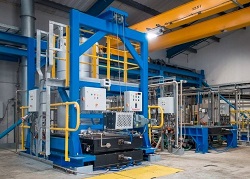
Image – Future industrial powder production at Metalysis.
For more information:
Metalysis