 WITec GmbH, the originator of commercial Raman imaging systems, has delivered a new alpha300 R instrument to the Center for Solar Energy and Hydrogen Research (ZSW) Baden-Württemberg in Ulm, Germany. The Raman microscope will be used in the “Powder-Up!” pilot plant in Ulm, where cathode materials for lithium-ion batteries will be produced and the scalability of fabrication methods will be investigated.
Lithium-ion batteries are the primary enabling technology in the current shift toward electric mobility and their performance is almost exclusively determined by the materials used. ZSW is at the forefront of innovative energy storage development and is constructing a new building for the “Powder-Up!” pilot plant over the next twelve months. The new facility will focus on making improvements in the next generation of battery electrode materials, and on scaling up their manufacturing processes. This work is set to have far-reaching effects in terms of battery performance, resource use, and unit costs.
According to Dr. Margret Wohlfahrt-Mehrens, head of the Accumulators Materials Research department, “Raman microscopy is becoming a standard method in applied battery research. It quickly provides detailed information about how different electrode formulations function and degrade over charge cycles.”
WITec GmbH won the Europe-wide public tender due to the high chemical sensitivity, spatial resolution and acquisition speed of its Raman imaging systems. The alpha300 R microscope offers the added benefits of modularity for integrating hardware such as electro-chemical cells, and high sample throughput for compiling industrially relevant volumes of data.
The “Powder-Up!” facility, funded by the Baden-Württemberg Ministry of Economic Affairs, Labor and Tourism and the German Federal Ministry of Education and Research (BMBF), is the first of its kind in Europe. Material batches of up to 100 kilograms can be produced in the new plant. Such quantities are required to produce large battery cells for electric cars or stationary energy storage units.
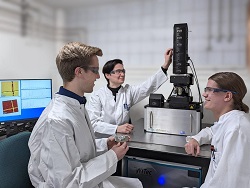
Image – Florian Klein (left) and Leon Gläser (right) from the ZSW in Ulm together with WITec Application Scientist Dr. Ievgeniia Iermak (middle) during training on the new Raman microscope.
For more information:
Oxford Instruments Group
The Center for Solar Energy and Hydrogen Research Baden-Württemberg