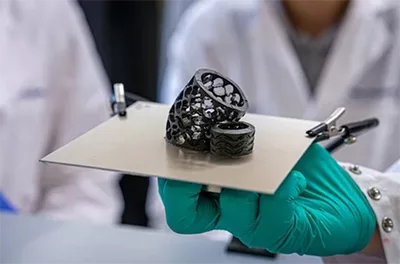
A team led by Rice University’s Yong Lin Kong has developed a soft yet strong metamaterial capable of rapidly changing its size and shape through remote control, marking a major step forward for ingestible and implantable medical devices. Unlike natural materials, metamaterials derive their unique properties from their physical structure rather than chemical composition. Kong’s design combines exceptional deformability with structural stability—an unprecedented feat in soft materials—allowing it to withstand compressive loads over ten times its own weight and perform reliably in extreme temperatures and harsh chemical environments.
“We programmed multistability, i.e. the ability to exist in multiple stable states, into the soft structure by incorporating geometric features such as trapezoidal supporting segments and reinforced beams,” said Kong, assistant professor of mechanical engineering at Rice’s George R. Brown School of Engineering and Computing. “These elements create an energy barrier that locks the structure into its new shape even after the external actuation force is removed.”
The metamaterial’s soft architecture helps address critical medical safety concerns such as gastric ulcers, puncture injuries and inflammation that can occur from implantable and ingestible devices made of rigid components.
Kong and his team used 3D printing to create molds that form interconnected microarchitectures of tilted beams and supporting segments. This design allows for rapid switching between open (off) and closed (on) states, and the transformed configuration is maintained even after the magnetic field is removed. By combining many such unit cells as “building blocks,” they form a 3D structure that can not only transform its shape but can also produce complex peristaltic motions to move or to deliver fluids in a controlled manner when actuated with a magnetic field.
Importantly, the material continued to function reliably even after prolonged exposure to mechanical stress and acidic corrosion, conditions that mimic the harsh environment of the human stomach.
“The metamaterial makes it possible to remotely control the size and shape of devices inside the body. This could enable lifesaving capabilities such as precisely controlling where a device stays, delivering medication where it’s needed or applying targeted mechanical forces deep inside the body,” Kong said. “We are now leveraging this metamaterial to develop ingestible systems that may one day treat obesity in humans or improve the health of marine mammals, and we are collaborating with surgeons at the Texas Medical Center to design wireless fluidic control systems to address unmet clinical needs.”
The first author of this study was Kong’s first graduate student, Taylor Greenwood, who has since graduated and started a faculty position at Brigham Young University. Kong’s other graduate students Brian Elder and Jared Anklam, postdoctoral associates Jian Teng and Saebom Lee and other collaborators were involved in the study. This research was supported by the National Institutes of Health and the Office of Naval Research.
For more information: Science Advances
Image: The new metamaterial designed by Kong and his team at Rice can be controlled remotely to rapidly transform its size and shape (Photos and video by Jorge Vidal/Rice University).