An international team led by Rutgers University-New Brunswick researchers has created a synthetic quantum structure by merging two lab-synthesized materials, previously thought impossible to combine. This exotic structure, developed through four years of experimentation, could provide new insights for quantum computing. The structure consists of distinct atomic layers: dysprosium titanate, used in nuclear reactors to trap radioactive materials and magnetic monopoles, and pyrochlore iridate, a magnetic semimetal known for its unique electronic, topological, and magnetic properties.
Individually, both materials are often considered “impossible” materials due to their unique properties that challenge conventional understanding of quantum physics.
The construction of the exotic sandwich structure sets the stage for scientific explorations in what is referred to as the interface, the area where the materials meet, in the atomic scale.
“This work provides a new way to design entirely new artificial two-dimensional quantum materials, with the potential to push quantum technologies and provide deeper insight into their fundamental properties in ways that were previously impossible,” said Jak Chakhalian, the Claud Lovelace Endowed Professor of Experimental Physics in the Department of Physics and Astronomy at the Rutgers School of Arts and Sciences and a principal investigator the study.
Chakhalian and his team are exploring a realm that follows the laws of quantum theory, a branch of physics that describes the behavior of matter and energy at the atomic and subatomic level. Central to quantum mechanics is the concept of wave-particle duality where quantum objects can possess both wave-like and particle-like properties – a foundational principle behind technologies such as lasers, magnetic resonance imaging (MRI) and transistors.
Chakhalian highly praised the efforts of three Rutgers students who made major contributions to the research: Michael Terilli and Tsung-Chi Wu, both doctoral students, and Dorothy Doughty, who graduated in 2024 and worked on the study as an undergraduate. In addition, Mikhail Kareev, who is a materials scientist working with Chakhalian, made a main contribution to the new synthesis method, as well as Fangdi Wen, a doctoral student who recently graduated from the Department of Physics and Astronomy.
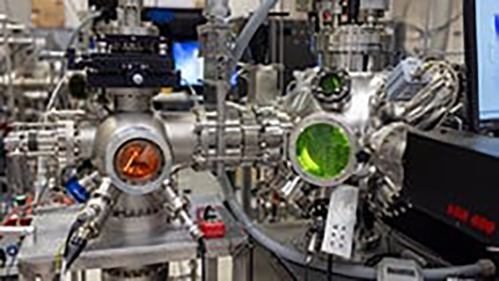
Chakhalian said that creating the unique quantum sandwich was so technically challenging that the team had to build a new device to accomplish the feat.
The instrument, called Q-DiP, short for quantum phenomena discovery platform, was completed in 2023. Q-DiP incorporates an infrared laser heater with another laser which enables the construction of materials on an atomic level, layer by layer. The combination allows the scientists to explore the most intricate quantum properties of materials down to ultra cold temperatures near absolute zero.
“To the best of our knowledge, this probe is unique in the U.S. and represents a breakthrough as an instrumental advance,” Chakhalian said.
The half of the experimental sandwich that is dysprosium titanate, also known as spin ice, possesses special qualities. Tiny magnets inside, called spins, are arranged in a way that looks exactly like the pattern of water ice. The unique structure of the tiny magnets in spin ice allows them to emerge as special particles called magnetic monopoles.
A magnetic monopole is a particle that acts like a magnet, but with only one pole – either north or south, but not both. This object, predicted in 1931 by the Nobel prize winner Paul Dirac, does not exist in free form in the universe and yet inside spin ice it emerges as a result of the quantum mechanical interactions within the material.
On the other side of the sandwich, the semimetal pyrochlore iridate is also considered exotic because it contains tiny relativistic particles called Weyl fermions. Again, surprisingly, though predicted by Hermann Weyl in 1929, these exotic particles, discovered in 2015 in crystals, move like light and can spin in different ways – left-handed or right-handed. Their electronic properties are very strong and resist certain types of disturbances or impurities, making them very stable when operated as a part of electronic devices. As a result, pyrochlore iridate can conduct electricity very well, respond in unusual ways to magnetic fields and show special effects when exposed to electromagnetic fields.
Chakhalian said the combined properties of the new material created makes it a promising candidate for use in advanced technologies, including quantum computing and especially for the next-generation quantum sensors.
“This study is a big step forward in material synthesis and could significantly impact the way we create quantum sensors and advances spintronic devices,” he said.
Quantum computing employs the principles of quantum mechanics to process information. Quantum computers use quantum bits or qubits that exist in multiple states simultaneously due to a quantum physical principle called superposition. This allows for complex computations to be performed much more efficiently than by classical computers.
The specific electronic and magnetic properties of the material developed by the researchers can help in creating very unusual and yet stable quantum states, which are essential for quantum computing.
When quantum technology becomes practical, it will significantly impact ordinary life by revolutionizing drug discovery and medical research, markedly improving operations, predictability and cost savings in finance, logistics and manufacturing. It also is expected to revolutionize machine learning algorithms, making artificial intelligence systems more powerful, the scientists said.
For more information: Nano Letters
Image: By building a unique, advanced machine, Rutgers scientists have created a structure with quantum qualities. The green window (right) is the main growth chamber where synthesis of the quantum “sandwiches” occurs. Within the amber window (left) are advanced characterization tools that uncover chemical and electronic properties of the grown quantum thin films without exposing them to air.