The aqueous sol-gel process can be defined as the conversion of a precursor solution into an inorganic solid by way of inorganic polymerization reactions induced by water. Usually, the precursor or starting compound is either an inorganic (i.e., no carbon), a metal salt (e.g., chloride, nitrate, sulfate), or a metal organic compound such as an alkoxide. Metal alkoxides are the most widely used precursors because they react readily with water and are known for many metals. Some alkoxides, which are widely used in industry, are commercially available at low cost (e.g., silicon, titanium, aluminum, zirconium), whereas others are rarely available or costly (e.g., manganese, iron, cobalt, nickel, copper, yttrium, niobium, tantalum). In comparison to the preparation of silicates from silicon alkoxides, sol-gel processing of transition metal oxides has been studied less, mainly due to the high reactivity of transition metal alkoxides.
The transformation of the precursor takes place in an organic solvent under the exclusion of water in nonaqueous sol-gel chemistry. In comparison to aqueous sol-gel chemistry, the list of potential precursors is longer and includes, in addition to inorganic metal salts and metal alkoxides, metal acetates and metal acetylacetonates. Organometallic compounds are also frequently used, but then the process is based on thermal decomposition rather than a sol-gel process. The family of metal oxide nanoparticles that are prepared by nonaqueous processes has grown and ranges from simple binary metal oxides to more complex ternary, multimetal, and doped systems.
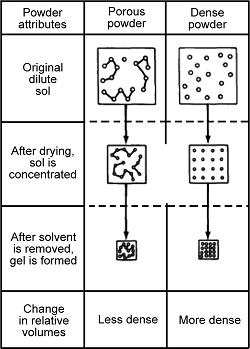
In powders formed by the sol-gel route, the sol structure can be in either an aggregated or dispersed structure, so that varying degrees or particle alignments are obtained when the conversion to a gel takes place. The image is a ball model of the structures that may be established. The density of the product can be altered from low (i.e., an aggregated sol) to high (i.e., a nonaggregated, or dispersed, sol).
Image – Formation of variable densities during the sol-gel process.
This information is from ASM Handbooks Online, Vol. 5A: Thermal Spray Technology, Coating Structures, Properties, and Materials. To find this information (subscription required), click on the link below and scroll down to Figure 7.
https://dl.asminternational.org/handbooks/edited-volume/12/chapter/133823/Feedstock-Material-Considerations-for-Thermal