To shield steel from the corrosive threats posed by sea air, Sandia National Laboratories researchers tested a variety of nickel mixtures as protective coatings on stainless steel. The researchers found that the specific material applied, and the specific application process used, impacted the properties of the coating, including how protective it was against corrosion.
Spent nuclear fuel is stored in quite a few coastal areas, where sea breezes can buffet canisters and deposit corrosive chloride salts such as sodium chloride, or more commonly known as table salt. Given enough time, the brine formed by these salts can corrode and pit stainless-steel canisters.
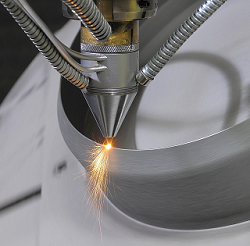
“Stress corrosion cracking is likely to eventually occur at some interim storage sites. We started looking at cold spray, which is a technique industry is very interested in, and at corrosion-resistant polymer coatings.”
Nuclear fuel rods that no longer produce enough heat for a nuclear power plant are first transferred to a pool of water at the reactor site. After several years in the pool, the spent nuclear fuel, in a rack called a fuel assembly, is cool enough that it is removed from the storage pool and placed inside a stainless-steel canister with many other fuel assemblies.
Each fuel rod has solid uranium oxide pellets inside a zirconium-based tube. The solid zirconium can break down if exposed to oxygen and moist air, so the canisters are filled with helium, an inert gas, to protect the rods.
These dry storage canisters are highly radioactive, and often are surrounded by additional layers of concrete or steel called overpacks. These overpacks protect workers from radiation while allowing air to circulate around the canisters, cooling them off, Charles Bryan, an expert on the storage of spent nuclear fuel and co-lead on the project, said.
Sandia engineer Sam Durbin is studying the possibility of radioactive materials coming out of potential stress corrosion cracks, which is key for evaluating the possible radioactive exposure risk to the general public, Bryan said. Instead, the primary concern with canister stress corrosion cracking is degradation of the fuel rods, and possibly exposing workers to radioactive material if they repackage the spent fuel for permanent geologic disposal, he added.
Researchers at Sandia and Pacific Northwest National Laboratory started exploring crack mitigation and repair technologies three years ago. These researchers, including engineer Erin Karasz, who started the project as a postdoctoral appointee and is now staff, have tested a variety of cold spray coatings to see if they could protect 1/2-inch-thick pieces of stainless steel from chloride corrosion.
“We found that you have to be very cognizant of the kind of material you are spraying onto what other kind of material,” said Karasz, who is the lead author of the Frontiers in Metals and Alloys paper. “I was surprised at how much the porosity determined the behavior when corrosion got going in between the cold spray coating and the steel. There seems to be a specific level of porosity, below which the cold spray has enhanced corrosion resistance.”
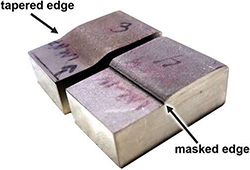
For this paper, the team tested three different nickel-based metal mixtures, two with known anti-corrosive properties and pure nickel as a comparison. They tried two different gases, nitrogen and helium. And they tested the effect of tapering off the coating on the metal or leaving a sharper edge between the coated area and the uncoated area.
They found that the gas used to spray on the metal particles had a strong impact on how porous, or spongy, the coating was. The porosity of the coating greatly impacted the corrosion behavior of the coating, Karasz said.
To test the corrosion protection of the cold spray coating, Karasz soaked the small pieces of cold-spray-coated stainless steel in a very corrosive ferric chloride bath for three days. This is a standard method to speed up chloride corrosion, but it isn’t a perfect model of what would occur to spent nuclear fuel canisters over hundreds of years, said Rebecca Schaller, a materials scientist and co-lead on the project. They found corrosion on all the samples, but the location and shape of the corrosion differed, suggesting further refinement of the coatings is needed.
Now the team is moving on to testing stainless steel with cold spray as well as other polymer coatings under more relevant atmospheric conditions, Schaller said.
Image – Cold spray samples with tapered and masked edges. Courtesy of Frontiers in Metals and Alloys.
For more information:
Sandia National Laboratories