Thermoelectric materials like germanium telluride (GeTe) can convert waste heat into electricity, offering a promising energy solution. To better harness this potential, researchers used a novel “neutron camera” technique to study GeTe’s structure. They found that while GeTe maintains its overall crystalline form—essential for conducting electricity—it also exhibits dynamic disorder, where parts of the structure move and slow heat conduction. This unique combination enhances thermoelectric efficiency, making GeTe a strong candidate for advanced solid-state devices like heat pumps and generators. The study also resolved previous inconsistencies in structural measurements.
Thermoelectric effects are produced by a heat gradient — hot to cold — in materials that resist heat flow while retaining electrical conductivity. Various types of measurements have produced conflicting results about the role of disorder in determining the properties of these energy materials.
In this study, researchers used a novel hybrid neutron scattering technique, the variable-shutter pair distribution function, or vsPDF, to measure the atomic properties of the thermoelectric material cubic germanium telluride (GeTe). Using a photography analogy, the technique’s ‘shutter speed’ can be changed by separating the components of the signal produced when neutrons probe a sample material. Using this method, researchers could distinguish between the material’s time-averaged (overall) structure and the instantaneous snapshots that capture only local disorder.
The results revealed the presence of local disorder while the overall structure remained crystalline. Calculations based on the results agree with the theory that the electronic conductivity in GeTe is maintained in specific crystallographic directions at the same time that thermal conductivity is disrupted.
For more information: Nature Materials
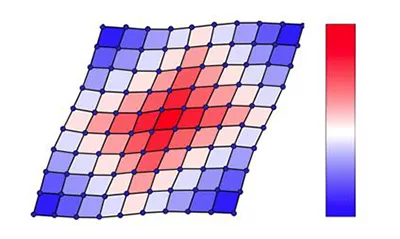
Image: Drawing illustrates in 2-D how electrical conductivity (red) tends to form in the direction of greater mechanical strain (yellow arrows). This property could enable controlling a material’s thermoelectric capabilities via chemical or mechanical methods.