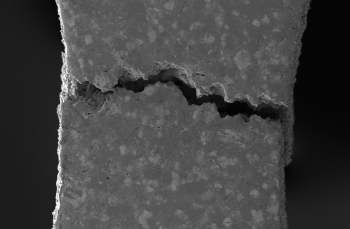
Blacksmiths fire metals before hammering them, as heat always softens metal, making it more malleable and easier to reshape. Or does it? In a surprising new study, engineers from Northwestern University (Evanston, Ill.) discovered that, in extreme conditions, heat does not soften pure metals—it strengthens them.
This new finding challenges long-held assumptions of how metals behave. It also could provide new insights for designing metals for futuristic applications in extreme conditions, such as hypersonic flight, extraterrestrial construction and advanced manufacturing.
“One of the most basic tenets in metallurgy is that if you heat a metal, it becomes softer,” said Northwestern’s Christopher Schuh, FASM, who led the study. “That is metallurgy 101. But we found that if you heat a pure metal and attempt to deform it at extremely high speeds, it flips. The opposite happens and the metal strengthens, resisting the deformation. It’s counterintuitive and makes us realize that, if we want to design materials for extreme conditions, we need to step away from conventional knowledge.”
Schuh is the dean of Northwestern’s McCormick School of Engineering, where he also serves as the John G. Searle Professor of Materials Science and Engineering. Ian Dowding, a Ph.D. graduate from Schuh’s group, is the paper’s first author.
Because conventional tests cannot reach these extreme conditions, Schuh and Dowding turned to an unconventional approach. The team used a specialized technique that blasts hard, microscopic particles at speeds up to hundreds of meters per second. At these speeds, the tiny particles ballistically impact the metal, stretching the metal to 100 million% of its original length in one second.
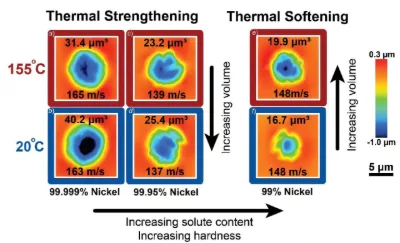
To gain additional data, the team performed the experiment with metal samples ranging from high purity to slightly alloyed versions of nickel, titanium, gold and copper and from temperatures ranging from room temperature up to 155°Celsius.
The results revealed a stark divide. As temperatures increased, pure metals became stronger and harder. Alloyed metals, however, behaved typically—becoming softer when heated.
This finding shocked the researchers. For decades, engineers have added impurities (or alloying elements) to metals to make them stronger. Pure iron, for example, is soft and bends easily. But adding carbon transforms iron into steel—a metal strong enough to support the world’s tallest skyscrapers and bridges that can hold millions of tons of weight across their lifetimes.
Schuh says that atomic vibrations are responsible for this counterintuitive behavior. If a particle slams into a pure metal at an extreme speed, it meets resistance from the metal’s vibrating atoms. At any given moment, some atoms are vibrating in a direction that opposes the deformation. As the temperature increases, those vibrations intensify, making it harder for the fast-moving particle to deform the metal’s surface. So, the metal becomes stronger.
But in alloys, impurities act as roadblocks that also resist deformations. In that case, heating the metal gives defects the energy to overcome these obstacles, restoring the typical hotter-is-softer behavior. Adding just 0.3% alloying elements was enough to completely reverse the metal’s counterintuitive response.
The engineers’ findings have implications for technologies that operate under intense heat and extreme strain rates. By heating a pure metal, it could become more resistant to sandblasting, ballistics and hypersonic speeds. Engineers also could tune a metal’s response to high temperatures by adjusting its purity.
Image – Laser scanning confocal micrographs are shown for (a,b) 99.999% Ni, (c,d) 99.95% Ni, and (e,f) 99% Ni with inserts showing the measured crater volume and impact velocities. Courtesy of Physical Review Letters, 2025, doi.org/10.1103/2mm1-rx7q.
************
For more information:
Northwestern University