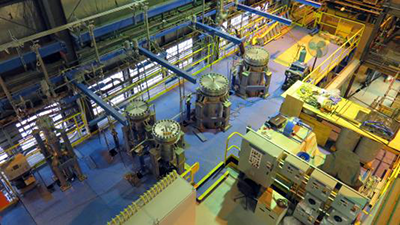
In the Mechanisms Engineering Test Loop (METL) at the U.S. Department of Energy’s (DOE) Argonne National Laboratory, component and instrument technology for liquid metal fast reactors is tested in sodium at temperatures up to 650°C. This high temperature, along with the reactivity of the sodium, requires unique solutions to simple measurements. One example is monitoring the liquid level in such a system. The ability to do so is very important to the nuclear industry, which is interested in designing sensor systems for use in advanced nuclear reactors. Improvements in this area could lead to more efficient reactors, more economical maintenance and operation of nuclear power plants, and faster commercialization of new designs.
Recently, scientists at Argonne developed a prototype mutual inductance level sensor (MILS), which can accurately and reliably make fluid-level measurements of liquid metals at high temperatures. The sensor utilizes electromagnetism and the electrically conductive nature of the liquid metal to provide continuous level measurements without having to come into contact with the liquid itself.
“The MILS system’s capability to read any electrically conductive working fluid at high temperatures provides new opportunities for operation in industries such as power generation and metallurgy,” said Teddy Kent, principal nuclear engineer at Argonne and lead author. “It’s possible for companies to optimize the MILS system, tailoring it to whatever environmental needs are necessary.”
Experimental data collected with the MILS at METL was used to validate a finite element analysis model in ANSYS Maxwell software that can be used to optimize sensor performance. Analysis results indicate the MILS will work effectively with liquid sodium and liquid lead coolants up to 650°C. Additionally, the operating frequency can be optimized for the material and geometry of the sensor and operating environment, and the sensor geometry can be selected to maximize signal sensitivity. The MILS system has been deemed accurate and reliable, and researchers will continue to improve the accuracy of calibration and temperature dependence of the sensor.
For more information: Argonne National Laboratory