Researchers at the University of Surrey, England, University of Cambridge, the Chinese Academy of Sciences, Xidian University, and Zhengzhou University, China, built a new kind of two-faced (bifacial) solar panel using single-walled carbon nanotubes as both front and back electrodes.
Dr. Jing Zhang, research fellow at Surrey’s Advanced Technology Institute, said, “Our bifacial cells can harvest sunlight from both front and back panels. This generates more energy and depends less on which angle the light hits them.”
The carbon nanotubes used measure 2.2 nanometers in diameter. They are very transparent and conduct electricity well. Zhang says “They have the potential to bring clean power within reach for millions of people—and we look forward to seeing how our invention will be used.”
The panels can generate more than 36 mW per square centimeter—and the back panel produced nearly 97% of the power that the front panel did. That compares to 75%–95% for most bifacial panels currently on the market.
Professor Ravi Silva CBE, the director of the Advanced Technology Institute, said, “The world cannot decarbonize without solar power. Yet that requires much cheaper solar energy than is currently available. Panels that can absorb the sun’s energy on both sides are a great way to make the technology more cost-effective.
“We have produced arguably the highest efficiency single junction solar cell to date. Our panels cost 70% less to make than a normal one-sided solar panel. This could significantly modify the market and simplify the architectures required based on perovskite solar cells.”
The study is published in the journal Nature Communications.
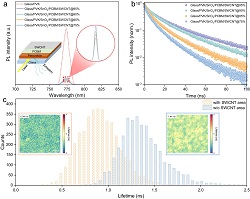
Image – Optical characterizations of semi-devices. a Steady-state PL of semi-devices with various SWCNT films. b Corresponding TRPL curves of semi-devices with SWCNT films in different thicknesses. c Charge lifetime statics of areas with and without SWCNTs (the fluence power is 0.4 µJ cm−2), and the inset pictures are charge lifetime mapping of areas with and without SWCNT films (the size of the area is 6 µm × 6 µm), with average lifetime marked on the top left. Courtesy of: Nature Communications (2024).
For more information:
University of Surrey