Tarasi et al. determined the influential variables relative to the crystalline phase formation in SPS coatings of the pseudo-eutectic alumina-8 wt% yttria-stabilized zirconia (YSZ) composite. The results indicated that particle feed size can affect the phase content structure, so that the larger particles resulted in the formation of more stable phases in the coating. Other feed parameters, including feed rate and solid content, influence the results through variations of the particle temperature. Furthermore, heat treatment at the alumina transformation temperature (1200 °C, or 2190 °F, for 24 h) leads to a coating composed of mainly the α-alumina phase in addition to cubic zirconia.
Tingaud et al. studied the influence of several spray parameters on the structure of alumina-zirconia coatings. The main characteristics of the plasma flow used to process the suspension droplets have been approximated by means of an analytical model describing the torch operating conditions according to the specific enthalpy at the nozzle exit and the gas thermophysical properties. This study looked at the evolution of spray beads with regard to the operating conditions and examined the effects of spray parameters and their interdependencies.
Particular focus examined the influence of the plasma stream to transfer thermal and kinetic energies and the spray distance, because this is more critical in the SPS process compared to atmospheric plasma spraying (APS). Thus, several coatings with different architectures have been manufactured in a reproducible way: dense or porous, graded pore level or composition, and, at last, Al2O3-ZrO2 finely structured multilayers.
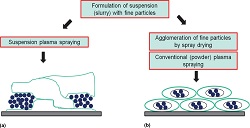
Podlesak et al. studied the influence of major operational process parameters, namely spray distance and plasma power level, on the microstructure of suspension plasma-sprayed hydroxyapatite (HA). Transmission electron microscopic studies with energy-dispersive x-ray spectroscopy enabled visualization and analysis of the two-zone microstructure. One zone, as in the image, contains crystals of HA, tetracalcium phosphate, and a phase rich in calcium oxide.
The zone corresponds to the lamellae usually observed in thermal spray coatings. The second zone contains fine HA grains that correspond to the fine nanometric and submicrometric solids from the suspension that were agglomerated and sintered in the cold regions of the plasma jet and on the substrate.
Image – Two routes leading to formation of a two-zone microstructure. (a) Suspension plasma spraying. (b) Agglomeration of coarse powders by spray drying followed by conventional plasma spraying.
This information is from ASM Handbooks Online, Vol. 5A: Thermal Spray Technology, Coating Structures, Properties, and Materials. To find this information (subscription required), click on the link below and scroll down to Figure 24.
https://dl.asminternational.org/handbooks/edited-volume/12/chapter/133823/Feedstock-Material-Considerations-for-Thermal