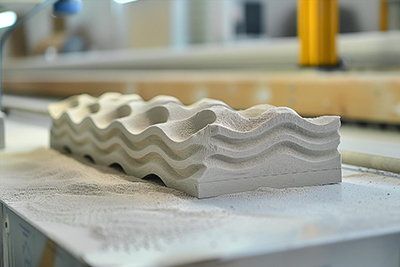
Researchers have successfully grown bacterial cells within sand-based construction materials, marking a significant advance in biodesign, which combines biological and architectural innovations to create more sustainable building materials. By integrating living organisms into construction, this approach aims to transform how structures are designed and built. Cyanobacteria, known for their unique biological properties, have the potential to solidify inorganic materials like CO2, highlighting the immense value of incorporating living systems into industrial processes, particularly in the construction sector.
The process explored involves the biological deposition of bacteria – such as cyanobacterial calcium carbonate precipitation – and its integration with a robotic deposition, namely a sand-based biomixture, within an architectural biofabrication workflow.
After successfully growing two bacterial strains in potential sand-based construction materials, the researchers used microbiological protocols, such as optical density and fluorescence measurements, to follow bacterial growth and activity. This was done with the larger goal of harvesting light through photosynthesis and harnessing it to CO2 deposition and the sedimentation of calcium carbonate for strengthening sand-based construction components.
Ultimately, the researchers managed to outline a robotic deposition system for sand-based mixtures.
The paper was co-authored by researchers at the Technion Israel Institute of Technology, in Haifa, Israel, in the Faculty of Architecture and Town Planning and the Faculty of Biotechnology and Food Engineering.
For more information: Research Directions: Biotechnology Design
Image: Scientists are revolutionizing construction by incorporating cyanobacteria into sand-based materials. This biodesign approach enhances sustainability and structural strength while introducing eco-friendly innovations.