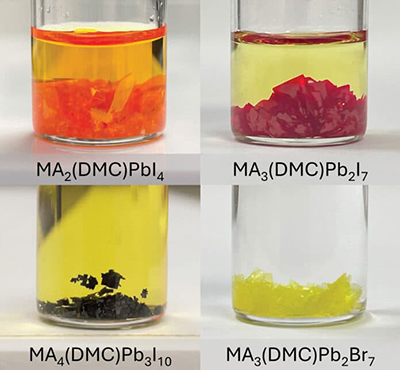
A team of scientists led by Associate Professor Nripan Mathews from NTU’s School of Materials Science and Engineering has successfully synthesized four groundbreaking types of perovskites, with Dr. Ayan Zhumekenov pioneering a unique method by incorporating dimethyl carbonate—a non-toxic solvent—into methylammonium-based perovskite crystals.
By examining the new crystal structures, the researchers found they could modify the band gap, which determines the material’s color and represents the energy needed for an electron to escape its bound state and achieve conductivity, by varying the proportions of methylammonium and dimethyl carbonate within the materials.
The capability to manipulate the width of the band gap is crucial for the diverse uses of perovskites. The newly developed 2D halide perovskites also demonstrate a dynamic “switchable” property.
The researchers discovered that one of the perovskites can alternate between two color states, transitioning from orange to red when subjected to a temperature of 80 degrees Celsius and returning to its initial color upon cooling back to room temperature.
The scientists showed that this color-changing reaction could be repeated for up to 25 cycles. This thermochromic switching phenomenon presents opportunities for applications such as smart coatings and heat-sensitive inks that alter color at varying temperatures.
The researchers are optimistic that their breakthrough will lead to technological advancements involving 2D halide perovskites in optoelectronics and other fields.
For more information: Journal of the American Chemical Society
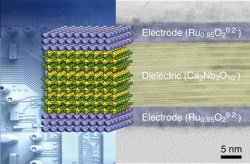
Image: NTU’s novel perovskites. Credit: NTU.