Researchers at the University of Sydney Nano Institute have made a significant advance in molecular robotics by developing custom-designed and programmable nanostructures using DNA origami, an innovative method that leverages the natural folding power of DNA to create new and useful biological structures. This approach has potential applications in targeted drug delivery systems, responsive materials, and energy-efficient optical signal processing. As a proof-of-concept, the researchers created over 50 nanoscale objects, including a “nano-dinosaur,” a “dancing robot,” and a mini-Australia that is 150 nanometers wide, a thousand times narrower than a human hair.
The research, led by first author Dr. Minh Tri Luu and research team leader Dr. Shelley Wickham, focuses on the creation of modular DNA origami “voxels” that can be assembled into complex three-dimensional structures. (Where a pixel is two-dimensional, a voxel is realized in 3D.)
These programmable nanostructures can be tailored for specific functions, allowing for rapid prototyping of diverse configurations. This flexibility is crucial for developing nanoscale robotic systems that can perform tasks in synthetic biology, nanomedicine and materials science.
Dr. Wickham, who holds a joint position with the Schools of Chemistry and Physics in the Faculty of Science, said, “The results are a bit like using Meccano, the children’s engineering toy, or building a chain-like cat’s cradle. But instead of macroscale metal or string, we use nanoscale biology to build robots with huge potential.”
Dr. Luu said, “We’ve created a new class of nanomaterials with adjustable properties, enabling diverse applications—from adaptive materials that change optical properties in response to the environment to autonomous nanorobots designed to seek out and destroy cancer cells.”
To assemble the voxels, the team incorporate additional DNA strands on to the exterior of the nanostructures, with the new strands acting as programmable binding sites.
Dr. Luu said, “These sites act like Velcro with different colors—designed so that only strands with matching ‘colors’ (in fact, complementary DNA sequences) can connect.”
He said this innovative approach allows precise control over how voxels bind to each other, enabling the creation of customizable, highly specific architectures.
One of the most exciting applications of this technology is its potential to create nanoscale robotic boxes capable of delivering drugs directly to targeted areas within the body.
By using DNA origami, researchers can design these nanobots to respond to specific biological signals, ensuring medications are released only when and where they are needed. This targeted approach could enhance the effectiveness of cancer treatments while minimizing side effects.
In addition to drug delivery, the researchers are exploring the development of new materials that can change properties in response to environmental stimuli. For instance, these materials could be engineered to be responsive to higher loads or alter their structural characteristics based on changes in temperature or acidic (pH) levels.
Such responsive materials have the potential to transform medical, computing and electronics industries.
For more information: Science Robotics
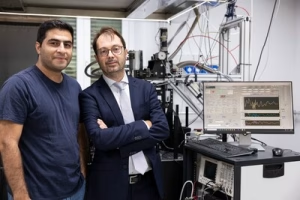
Image: Dr. Minh Luu aligning and focusing an image on the Sydney Microscopy and Microanalysis transmission electron microscope to view a DNA origami nanostructure. Credit: Stefanie Zingsheim/University of Sydney