Researchers at Northwestern University and Tel Aviv University have addressed a key challenge in developing affordable robotic touch by identifying a flaw in the materials used for robotic skin. They discovered that inexpensive silicone rubber composites form insulating layers on their surfaces, which block electrical contact between the sensing polymer and electrodes, leading to inaccurate readings. By eliminating this issue, the team has paved the way for low-cost robotic skins capable of mimicking human touch—enabling robots to detect curves and edges for more precise object handling.
“A lot of scientists misunderstand their sensor response because they lump together the behavior of the contacts with the behavior of the sensor material, resulting in inconsistent data,” Grayson said. “It turns out, if you are not aware of this problem, you can publish papers which no one can reproduce. Our work identifies the exact problem, quantifies its extent both microscopically and electrically, and gives a clear step-by-step trouble-shooting manual to fix the problem.”
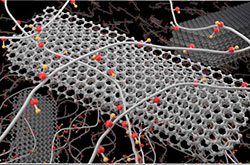
The rubber that can be used for typical robotic skin, called an elastomer, is flexible, lightweight and inexpensive, and when electrically conducting fillers like carbon nanotubes are added to the mix, the resulting composite becomes an ideal candidate for a touch sensor, whose resistance changes locally when pressed. But to receive electrical signals, the sensors need to be electrically contacted, and the researchers detected a thin insulating layer ever-present in such composites which could drastically change the behavior of the contacts. Just by sanding down the ultrathin insulation layer, the team was able to achieve a much stronger electrical contact and calibrate the thickness of the insulating layer both electrically and microscopically.
“All interesting things happen at the interface,” said co-author and professor at Tel Aviv University Noa Lachman. “This publication not only shows the importance of sensor interfaces, but also the importance of working at the nexus between two different disciplines: materials science and electrical engineering. Materials experts suspected the presence of this insulating external layer in conductive polymer composites for years but couldn’t understand its electrical effects. Each of us has one piece of the puzzle, but only together can we get the whole picture.”
Robotics in particular can be tricky in part because it requires so many types of expertise. The polymer materials scientist designing the functional electronic material for a robot, for example, does not have the same training and skills as the electrical engineer whose electronics will process the sensor signals. Grayson said the “contact preparation” challenge was precisely where the conversation about this research began.
“That’s why our collaboration with Tel Aviv is essential – they know the materials science that we don’t know,” Grayson said. “We rely on them to prepare the materials we are studying, then we take and study the material before turning around to help the Tel Aviv materials scientists characterize their materials better.”
Producing new materials — and then reproducing them — requires consistency across many different variables that are often difficult or even impossible to control. In exposing the question of reproducibility in much of the literature on touch sensing, Grayson challenges the research community to hold itself to a higher standard with the quality check described in the paper. As awareness of this problem spreads among researchers, new publications can be more rigorously relied upon to advance the field with new capabilities.
For more information: Journal of Advanced Electronic Materials