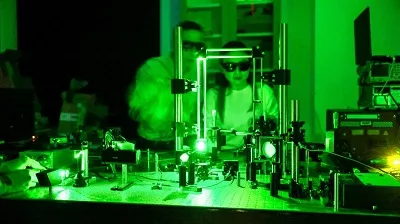
Researchers at the Weizmann Institute of Science, Israel, introduce a novel powerful tool—the cryogenic quantum twisting microscope (QTM)—to explore quantum phenomena.
Using this pioneering instrument, scientists have observed—for the first time—the interactions between electrons and an exotic atomic vibration in twisted sheets of graphene, called a “phason.” These findings shed new light on the mysterious superconductivity and “strange metallicity” that emerge when graphene sheets are rotated to the “magic angle.”
When electrons and phonons are coupled, remarkable new phenomena can emerge. Perhaps the most intriguing phenomenon occurs when the coupling enables phonons to effectively bind electrons into pairs, resulting in superconductivity—a state where electrical current flows without resistance. Despite its crucial role, measurements of electron-phonon coupling for individual phonon modes have remained an outstanding challenge.
Two years ago, a team of researchers from the Weizmann Institute of Science, led by Prof. Shahal Ilani, developed the QTM. This microscope uses an atomically-thin van-der-Waals material at its tips as a quantum interferometer, enabling direct measurement of the electronic wavefunctions within a quantum material. With their original QTM, operating at room temperature, they were able to image the electronic spectrum of various materials.
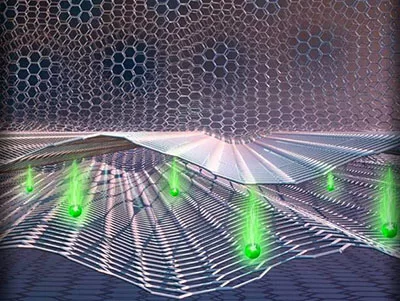
Now, creating a QTM that works at cryogenic temperatures, the team discovered that it can also image phonons with unprecedented precision. The new QTM employs an inelastic process, where electrons tunneling between two atomically-thin layers emit a phonon whose energy and momentum are controlled by adjusting the voltage bias and twist angle between the layers. By systematically tuning these parameters, they could map the complete phonon energy spectrum of the material under investigation.
“Our technique not only measures the phonon spectrum but also quantifies how strongly electrons couple to each phonon mode,” says Dr. John Birkbeck, a lead author of this study. “Materials host numerous phonon modes, each can have a wide range of momenta. Our microscope quantitatively reveals how electrons interact with each mode individually, providing unprecedented insight into electron-phonon dynamics.”
Applying this novel technique to twisted bilayer graphene yielded a surprising discovery: a unique low-energy vibration known as a “phason,” whose coupling to electrons grows stronger as the graphene layers approach the magic angle. This behavior had never been observed before and suggests that phasons may play a key role in the strange metal behavior and superconductivity observed in this system.
With this significant expansion in its capabilities, the QTM is poised to become a transformative instrument for quantum materials research. Its unique ability to probe both electronic states and collective excitations paves the way for discoveries relevant to quantum computing, sensing technologies, and future quantum electronic devices.
Image – Illustration of electrons tunneling between twisted layers of graphene emitting a unique lattice vibration termed a “phason.” Courtesy of Weizmann Institute of Science.
************
For more information:
Weizmann Institute of Science