Scientists at the Raman Research Institute have made a breakthrough in quantum materials by discovering a novel method to identify a key property called a topological invariant—an unchanging characteristic even when a material is deformed. This property is essential for understanding the unusual behaviors of topological materials, which are foundational to future technologies like quantum computing, fault-tolerant electronics, and energy-efficient systems. Historically, detecting these unique traits has been a major challenge, making this advancement a significant step forward in the field.
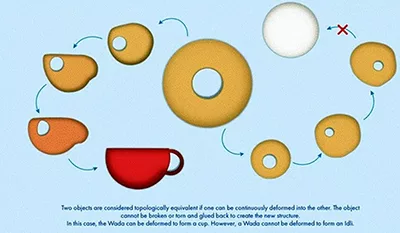
To grasp the concept of topological invariance, scientists often use the analogy of a “vada” (South Indian snack) and a coffee cup. Both have a single hole, making them topologically equivalent – one can be continuously deformed into the other without cutting or gluing. In contrast, a vada and an “idli” (steamed rice cake) are not topologically equivalent, as they possess different numbers of holes, making continuous deformation impossible. This fundamental idea of “counting holes” is key to unlocking the hidden properties within these exotic materials.
In materials such as topological insulators and superconductors, electrons exhibit unusual behavior directly influenced by the material’s quantum “shape.” These shapes are defined not by their physical appearance but by deeper, intrinsic topological invariants, such as winding numbers in one-dimensional systems or Chern numbers in two-dimensional systems. These numbers act as a kind of hidden code, dictating how particles move through the material.
The RRI team, led by Professor Dibyendu Roy and PhD researcher Kiran Babasaheb Estake, has found an innovative method to detect this hidden code using a property called the spectral function. This function acts as a “quantum fingerprint,” providing insights into how energy and particles behave within the material. Their research specifically focused on analyzing the momentum-space spectral function (SPSF).
Traditionally, researchers relied on techniques like angle-resolved Photoemission Spectroscopy (ARPES) to study electron behaviour. The groundbreaking new research, recently published in Physical Review B, demonstrates that the same spectral function holds the keys to unlocking a material’s hidden topology. This offers a revolutionary way to “see” the underlying structure without direct observation.
“The spectral function has been used for many years as an experimental tool to probe physical quantities such as the density of states and the dispersion relation of electrons in a system through ARPES. It was not seen as a tool to probe topology or topological aspects of an electronic system,” stated Kiran Babasaheb Estake, a PhD student in theoretical Physics at RRI and the lead author of the study.
He added, “We have demonstrated through various examples that the spectral function also contains signatures about a system’s topology.”
This study potentially offers a universal tool for exploring and classifying topological materials. Its implications could pave the way for new discoveries in condensed matter physics, ultimately benefiting the development of quantum computers,next-generation electronics, and more energy-efficient systems.