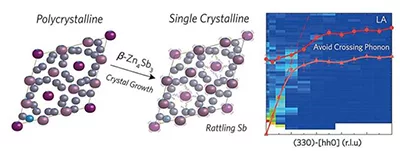
Researchers have significantly improved the efficiency of β-Zn₄Sb₃, a thermoelectric material that converts waste heat into electricity, without using rare or costly elements. This tellurium-free compound was studied using advanced neutron scattering techniques, revealing that tiny heat vibrations—called phonons—were being disrupted by “rattling” atoms within the crystal structure. This effect, known as phonon avoided crossing, greatly reduces heat transfer through the material, enhancing its energy-harvesting capabilities.
Thanks to this effect, the material’s thermal conductivity dropped to extremely low levels—great news for thermoelectric performance. Even better, the researchers found that the single-crystal version of this material also conducts electricity better than its polycrystalline counterpart, reaching a high power conversion efficiency of 1.4%.
These results show that smart phonon control can lead to high-performance, eco-friendly materials for converting heat into power.
In thermoelectric materials, avoided crossing refers to the interaction between propagating phonons and localized vibrational modes, where their energy dispersions repel each other rather than intersect. This phenomenon occurs under specific conditions, such as crystal symmetries or vibrational mode couplings.
However, when researchers developed the single-crystal β-Zn4Sb3, they observed an unexpected, avoided crossing, revealing unique phonon behavior that deviated from conventional thermoelectric materials.
The article explores the thermoelectric performance of single-crystalline β-Zn4Sb3, a tellurium-free material, by uncovering the microscopic mechanisms that lead to its ultralow lattice thermal conductivity (κL).
Using inelastic neutron scattering (INS), the researchers provide the first experimental observation of avoided crossing between longitudinal acoustic phonons and low-energy rattling modes. This interaction causes a significant reduction in phonon group velocity—from over 4000 m/s to about 591 m/s—and shortens phonon lifetimes to under 1 picosecond, both of which contribute to strongly suppressed heat transport.
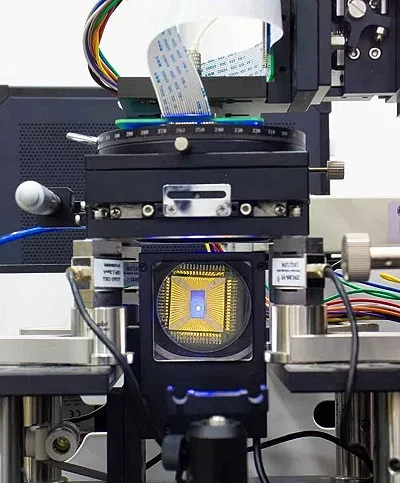
The β-Zn4Sb3 single crystal achieves a κL of approximately 0.36 W/m·K in the 300–600 K range and a peak thermoelectric figure of merit (zT) of 1.0 at 623 K. Additionally, device-level testing shows a conversion efficiency (η) of 1.4% in a single-leg thermoelectric module—one of the highest reported for undoped Zn4Sb3.
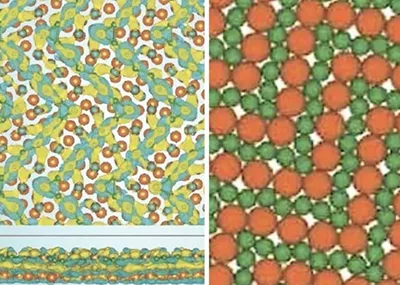
Structural characterizations via TEM reveal a grain-boundary-free lattice with uniformly distributed moiré fringes, attributed to Zn concentration variations.
These nanoscale features further enhance phonon scattering without degrading electronic performance. Compared to polycrystalline samples, the single crystal exhibits significantly better electrical conductivity due to fewer defects and optimized carrier mobility.
“This discovery shows how heat flow can be engineered to design more efficient and sustainable energy technologies—without depending on scarce resources,” says Prof. Hsin-Jay Wu.
For more information: Advanced Science
Image: Phonon dispersion map single crystalline β-Zn4Sb3 of at 300 K, measured in the longitudinal scan along [hh0]. Credit: National Taiwan University