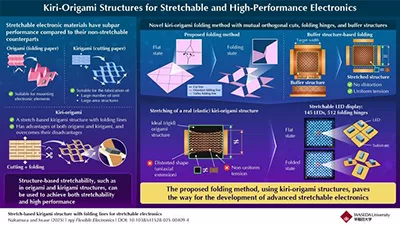
Stretchable electronics are increasingly used in devices like smartphones, smartwatches, curved displays, and wearable sensors, but they face a trade-off between flexibility and electrical performance, as stretchable materials like elastomers typically underperform compared to rigid ones like metals or semiconductors. To address this, researchers have turned to origami and kirigami—Japanese techniques of folding and cutting paper—to enable stretchability in non-stretchable electronic materials. Origami creates bendable structures with hinges suitable for mounting rigid components, while kirigami uses slits to allow full structural deformation, making it ideal for large-area designs but less compatible with rigid parts.
In a groundbreaking study, Professor Eiji Iwase and Mr. Nagi Nakamura from the Department of Applied Mechanics and Aerospace Engineering at Waseda University, Japan, developed an innovative hybrid technique using kiri-origami structures.
“In this study, we have proposed a kiri-origami structure that incorporates both folding and cutting lines, combining the strengths of origami and kirigami while canceling out their weaknesses,” explains Iwase. “This structure enables large-number-of-unit, large area electronic devices, allowing rigid electronic components to be folded by stretching.”
The proposed kiri-origami design features a mutual orthogonal cutting line pattern. In this pattern, triangular joint panels consisting of two folding lines act as hinges and connect two square panels formed by the cutting lines. When stretched from a flat state, the square panels rise and rotate. This opens slits between the panels, ultimately resulting in a Z-shape around the hinges. This structure allows simultaneous mounting of rigid components and stretching to a target shape, while also supporting large-area and large-number-of-unit structures.
In ideal kiri-origami structures, called rigid-origami structures, the panels do not deform, and the hinges rotate frictionlessly. However, for a real stretchable electronic substrate, panel deformation and elastic repulsive forces cannot be overlooked, giving rise to an “elastic origami model.” To investigate these effects, the researchers tested the deformation of a rectangular elastic origami model using a simple stretching method, where the sample is clamped and stretched uniaxially. They observed that the elastic model deformed differently from the rigid model. They found that this difference occurs due to two factors: first, the clamping edges in the rigid model are free edges, while they are fixed in the elastic model. Second, the entire structure distorts while stretching due to non-uniform tension.
To mitigate these effects, the researchers developed a new folding method that introduces buffer structures. The buffer structures are trapezoidal extensions that connect all the edges of the kiri-origami structure to the clamps. The width of the shorter edge of the buffer structures is equal to the initial width of the kiri-origami structure, while the larger edge is set to the target stretched width of the rigid model. When a tensile force is applied, they extend and behave like springs. As a result, the entire structure stretches in two directions, matching the deformation of the rigid model while maintaining uniform tension.
The researchers demonstrated this technique by fabricating a stretchable display with more than 500 hinges and 145 LEDs. All hinges could fold up simultaneously, and the device’s performance was maintained before and after folding.
“Our approach makes it possible to develop stretchable electronic devices that can accommodate complex shapes and do not compromise on performance, including next-generation high-performance wearable sensors, curved displays, and flexible sensors and actuators for human assistance robots,” remarks Iwase.
This kiri-origami technique thus offers a scalable, structurally engineered solution for integrating high-performance electronic materials into flexible, stretchable devices—paving the way for innovative applications in electronics, healthcare, and robotics.
For more information: npj Flexible Electronics
Image: Kiri-origami structures combine the benefits of both origami and kirigami, incorporating their advantages while canceling their disadvantages, enabling the development of high-performance, stretchable, large-number-of-unit electronic devices.