Researchers at Lawrence Livermore National Laboratory (LLNL) and their collaborators conducted experiments with gold to learn more about the unexpected structures and properties it would adopt under high pressure. The results, which show gold switching structure at 10 million times the Earth’s atmospheric pressure, are essential for planetary modeling and fusion science.
Gold is a common reference material for high-pressure science. It is often used to calibrate static measurements of pressure because it is chemically stable and is easy to detect with x-rays. Its behavior at low pressure conditions is relatively well-understood, but there have been some historical discrepancies when it comes to extreme pressures.
Knowing precisely how gold behaves ensures that every other experiment using it as a calibrant, from studying planetary cores to designing new materials, is grounded in a robust and validated understanding of gold’s behavior,” said LLNL scientist and author Amy Coleman.
But reaching these pressures is extraordinarily difficult. To obtain their measurements, the authors created tailored laser pulses at the National Ignition Facility (NIF) and the OMEGA EP Laser System at the University of Rochester. Those pulses allowed them to access ultra-high pressures at lower temperatures where the gold is still in a solid state.
The process also required ultra-precise timing, with atomic-scale x-ray diffraction snapshots taken in a billionth of a second.
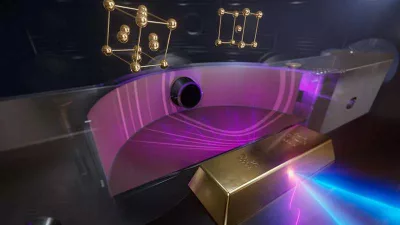
Under extreme pressure, some gold atoms arranged themselves into a body-centered cubic structure, where atoms are located at each corner of a cube and one atom is in the exact center. But some of the original face-centered structure also persisted, providing evidence of a coexistence between the states.
“These experiments extend structural measurements of gold into the terapascal regime and highlight the need for temperature diagnostics to refine phase boundaries,” said Coleman. “They provide a stronger foundation for using gold as a high-pressure standard and for exploring matter under extreme conditions.”
Image – Depiction of gold compressed to ultra-high pressures by laser pulses at the National Ignition Facility. X-rays scatter from the sample, producing diffraction patterns that reveal how its atomic structure changes under extreme compression. Courtesy of Jacob Long/LLNL.
************
For more information:
Lawrence Livermore National Laboratory