Australian scientists have made a significant leap forward in energy storage technology by developing and testing the world’s first proof-of-concept quantum battery, new research reveals.
Researchers say the technology could transform how we store and use energy in the future, paving the way for super-fast charging of devices.
Led by the Commonwealth Scientific and Industrial Research Organization (CSIRO), Australia’s national science agency, in collaboration with University of Melbourne and RMIT University, the research was published in Nature Light: Science & Applications.
“Similar to conventional batteries, quantum batteries charge, store and discharge energy. But while everyday batteries rely on chemical reactions, quantum batteries leverage properties of quantum mechanics,” said University of Melbourne’s Associate Professor James Hutchison who was involved in the research.
“The advantage of quantum is that the system absorbs light in a single, giant ‘super absorption’ event and this charges the battery faster.”
The University’s Ultrafast Laser Laboratory in the School of Chemistry was used to test and confirm the prototype’s fast-charging behavior using advanced spectroscopy techniques.
“The unique capabilities of our Ultrafast Laser Lab, including dual femtosecond laser amplifiers and tuneable optical parametric amplifiers, were critical in enabling us to record ultrafast signals over orders of magnitude in time,” said the university’s Professor Trevor Smith, also involved in the research.
The research offers a glimpse into a possible future powered by quantum energy storage.
“The research and proof-of-concept validates the exciting potential of quantum batteries to achieve rapid, scalable charging and energy storage at room temperature, laying the groundwork for next-gen energy solutions,” said Dr. James Quach, quantum science and technologies science leader at CSIRO, who led the team that engineered the prototype.
“Our findings confirm a fundamental quantum effect that’s completely counterintuitive: quantum batteries charge faster as they get large.
“While there’s still much work to be done in quantum battery research, we’ve made an important move towards realizing the possibilities. The next step right now for quantum batteries is extending their energy storage time.”
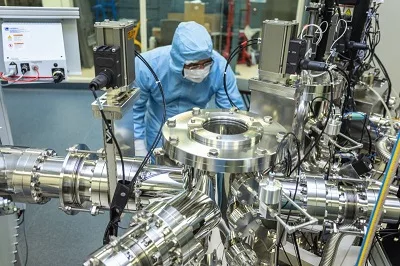
Image – The CSIRO’s quantum battery fabrication lab. Courtesy of: CSIRO.
For more information:
University of Melbourne
https://www.unimelb.edu.au/