A sheet of twisted carbon nanotubes has revealed a long-suspected but previously unmeasured capability, as researchers at Rice University created highly ordered films of chiral nanotubes — carbon cylinders with left- or right-handed twists — that can convert the color of light at rates two to three orders of magnitude greater than conventional materials. The findings confirm decades-old theoretical predictions and suggest ultrathin nanotube films could advance faster optical communications, flexible photonic chips and light-based computing systems that largely remain in early stages.
Since their discovery in the 1990s, carbon nanotubes have been touted as carriers of enormous technological potential due to their tunable conductivity, high mechanical strength, flexibility and ultralow weight. However, they are also difficult to purify and align into larger material architectures.
This holds true for chiral CNTs, whose “handedness” makes them especially difficult to work with.
“Typically, when we have a macroscopic ensemble of carbon nanotubes, half of them are right-handed and the other half are left-handed,” said Junichiro Kono, a senior researcher on the study. “So, their chiral properties cancel each other out.”
That cancellation effect has prevented researchers from measuring one of the material’s most anticipated properties, second harmonic generation (SHG), which occurs when two light waves pass through a material and combine into one new wave with twice the frequency and half the wavelength. For example, due to SHG, two infrared light waves invisible to the human eye can be converted into visible light.
“Theory predicts chiral CNT should be particularly good at such conversion,” said Hanyu Zhu, a Rice materials scientist who led the study alongside Kono. “However, no one was able to quantify this ability because it requires high-quality, pure chiral CNT crystal.”
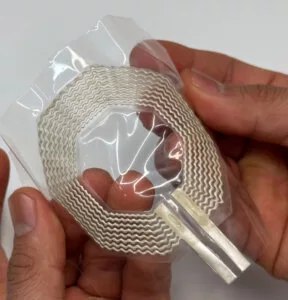
The Rice-led team solved that challenge by isolating nanotubes with a single handedness – a step carried out by the group of Kazuhiro Yanagi at Tokyo Metropolitan University – aligning them in the same direction and assembling them into thin films spanning several centimeters.
“We successfully made a wafer of film packed closely with chiral CNTs that showed uniform optical properties,” said Kono, director of the Smalley-Curl Institute at Rice and Karl F. Hasselmann Professor in Engineering, professor of electrical and computer engineering and materials science and nanoengineering, and physics and astronomy.
When illuminated with laser pulses, the chiral CNT films produced a “giant” SHG response thanks to their one-dimensional structure, where “one-dimensional” describes materials with two dimensions on the order of a nanometer and a third, much larger, dimension that gives rise to wire- or tubelike architectures.
This structure intensifies interactions between light and matter, particularly through coupled electron-hole states known as excitons. The importance of excitons in the SHG process was theorized by two team members, Vasili Perebeinos at the University at Buffalo and Riichiro Saito at Tohoku University.
“For the first time, we were able to make a more accurate prediction of one-dimensional second-order nonlinear optical response and experimentally demonstrated it,” said Zhu, associate chair and professor of materials science and nanoengineering.
SHG already plays an important role in laser technology and optoelectronic systems. The stronger the SHG effect is, the smaller the devices can be to control and convert light for technology. Chiral CNTs not only outperform materials currently in use in terms of SHG, but they are also flexible, widening the range of applications they could serve.
“CNT is a promising flexible semiconductor for electronics and photonics,” Zhu said. “The film may be easily integrated with silicon photonics for optical information processing and communication.”
For more information: ACS Nano
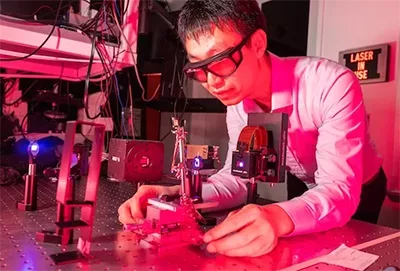
Image: Hanyu Zhu is the William Marsh Rice Chair and associate professor of materials science and nanoengineering at Rice University. (Photo by Jeff Fitlow/Rice University)