A UCLA-led study shows that adding graphene oxide, a carbon-based nanomaterial, to cement mixtures can produce stronger, more durable concrete, with performance driven more by even distribution than by quantity. Researchers found that ultrasonic treatment improves dispersion and delivers early strength gains at lower dosages, while controlled use of polymer surfactants helps enhance long-term strength by refining pore structures and reducing microcracks. The findings suggest practical ways to use less cement and lower carbon dioxide emissions tied to cement production.
Concrete is the world’s most widely used building material. Cement, the binding ingredient in concrete, accounts for about 8% of global carbon dioxide emissions. Enhancing the efficiency of cement use is therefore essential, as it would reduce the amount needed to build infrastructure — including buildings, roads and bridges — and help lower overall emissions. Graphene-enhanced concrete could last longer and require fewer repairs because stronger concrete cracks less easily and better resists water intrusion and corrosion, which in turn can increase its service life.
Researchers have known for more than a decade that adding graphene oxide to cementitious mixtures can increase concrete’s mechanical performance. However, earlier approaches produced inconsistent results, limiting suitability for commercial use.
To address this challenge, the UCLA team first dispersed graphene oxide powder in water and used ultrasound — the same type of technology found in inexpensive jewelry cleaners — to break up clumps and create a uniform mixture. They then added a moderate amount of polycarboxylate ether, or PCE, a common polymer additive that improves the mixture’s fluidity without adding extra water. This optimized sequence controls the exposed surface area of graphene oxide, thereby delivering strength gains at very low dosages, as little as 0.01% by mass of cement.
Graphene oxide is a nanomaterial derived from graphite and composed of carbon sheets one atom thick. In laboratory tests, adding graphene oxide to cementitious formulations using the optimized process improved the compressive strength by up to 25% after 28 days. The porosity was also significantly reduced by up to 50% as graphene oxide bridged microcracks, resulting in a denser structure.
“This study provides a comprehensive mechanistic framework to combine ultrasound processing, particle dispersants and small additions of graphene oxide to improve the performance of concrete,” said study co-corresponding author Gaurav Sant, a professor of civil and environmental engineering and the Pritzker Professor of Sustainability at the UCLA Samueli School of Engineering. The breakthrough builds on a long-term collaboration between Sant and co-corresponding author Richard Kaner, a distinguished professor of chemistry and biochemistry, through UCLA’s Institute for Carbon Management.
“Our group has spent nearly 20 years refining the synthesis and processing of graphene oxide, and more than a decade working with industry partners to scale production with consistently high quality,” said Maher El-Kady, a researcher working with Kaner. “It’s exciting to see that long-term effort culminate in a study with such clear societal relevance.”
The study’s first author is UCLA postdoctoral researcher Zhi Wan. The other co-corresponding authors are Torben Gädt, chair for the chemistry of construction materials at the Technical University of Munich, and Samanvaya Srivastava, a UCLA associate professor of chemical and biomolecular engineering. Additional UCLA authors include postdoctoral scholar Rui Xiao and chemical and biomolecular engineering graduate student Vihar Trada. Arizona State University researchers Sahil Surehali, a postdoctoral scientist, and Narayanan Neithalath, a professor of sustainable engineering, are also authors on the study.
At UCLA, Kaner holds the Dr. Myung Ki Hong Endowed Chair in Materials Innovation and has a joint appointment in materials science and engineering at UCLA Samueli. Sant is the director of the Institute for Carbon Management and holds a joint appointment in materials science and engineering. Both are faculty members with the California NanoSystems Institute.
For more information: ACS Applied Engineering Materials
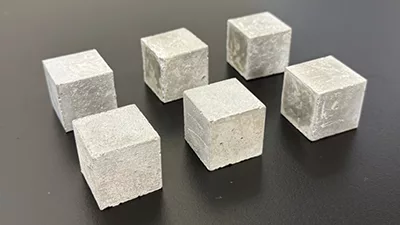
Image: Cement test samples (3-centimeter cubes) containing graphene oxide.