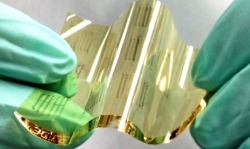
Researchers at Stanford University, Calif., developed a process to create flexible chips that can tolerate power fluctuations in much the same way as silicon circuitry. “This is the first time anyone has designed flexible carbon nanotube (CNT) circuits that have both high immunity to electrical noise and low power consumption,” says Zhenan Bao, a professor of chemical engineering.
In principle, CNTs should be ideal for making flexible electronic circuitry. These ultra-thin carbon filaments have the physical strength to take the wear and tear of bending and the electrical conductivity to perform any electronic task. But until now, flexible CNT circuits didn’t have the reliability and power-efficiency of rigid silicon chips.
Electricity can travel through semiconductors in two different ways It can jump from positive hole to positive hole (P-type), or it can push through a bunch of negative electrons like a beaded necklace (N-type).
Most importantly, it has been discovered that circuits based on a combination of P-type and N-type transistors perform reliably even when power fluctuations occur, and also consume much less power. This type of circuit with both P-type and N-type transistors is called a complementary circuit.
Over the last 50 years engineers have become adept at creating this ideal blend of conductive pathways by changing the atomic structure of silicon through the addition of minute amounts of useful substances—a process called “doping” that is conceptually akin to what our ancestors did thousands of years ago when they stirred tin into molten copper to create bronze.
The challenge is that CNTs are predominately P-type semiconductors with no easy way to dope the carbon filaments to add N-type characteristics. Engineers overcame this challenge by treating the CNTs with a chemical dopant they developed known as DMBI. An inkjet printer was used to deposit the substance in precise locations on the circuit, marking the first time any flexible CNT circuit was doped to create a P-N blend that can operate reliably despite power fluctuations and with low power consumption.
This process also has some potential application to rigid CNTs. Although rigid CNTs have been doped to create this immunity to electrical noise, this precise and finely tuned process out-performs prior efforts, suggesting that it could be useful for both flexible and rigid CNT circuitry.
Bao research is focused on flexible CNTs, which compete with other experimental materials, such as specially formulated plastics, to become the foundation for bendable electronics, just as silicon has been the basis for rigid electronics.
As a relatively new material, CNTs are playing catch-up to plastics, which are closer to mass market use for such things as bendable display screens. The new doping process moves flexible CNTs closer toward commercialization because it shows how to create the P-N blend, and the resultant improvements in reliability and power consumption, already present in plastic circuits.
Although much work lies ahead to make CNTs commercial, Bao believes these carbon filaments are the future of flexible electronics, because they are strong enough to bend and stretch, while also being capable of delivering faster performance than plastic circuitry, “CNTs offer the best long term electronic and physical attributes,” she says.
More information:
Stanford University