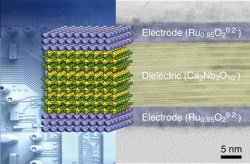
Researchers at the Japan National Institute for Materials Science, International Center for Materials Nanoarchitectonics, and Shinshu University in Japan report that they have developed high-performance ultrathin capacitors. They used conductive Ru0.95O20.2- and dielectric Ca2Nb3O10- nanosheets as core device components. By using solution-based assembly, they created a sandwich consisting of layers of two different types of oxide nanosheets to produce an ultrathin capacitor. The new capacitor has a stable capacitance density (~27.5µF cm-2), which is 2000 times higher than that of currently available commercial products.
The researchers see a number of possible extensions to the current work. They conclude that “The virtually infinite varieties of oxide nanosheets, which can be used to assemble various nanosheet architectures, suggest that 2D heterointerfaces will offer an unprecedented versatility for the realization of new 2D states and molecularly thin film devices even beyond graphene.”
Electronics are getting smaller all the time, but there’s a limit to how tiny they can get with today’s materials. Takayoshi Sasaki and co-workers have now developed a way to shrink capacitors, key components that store energy, even further, which could accelerate the development of more compact, high-performance next-generation devices (“All-Nanosheet Ultrathin Capacitors Assembled Layer-by-Layer via Solution-Based Processes”).
Many recent improvements have already downsized capacitors significantly. But current technology has almost reached its limit in terms of materials and processing, which in turn limits the performance that manufacturers can achieve. In response, the researchers have gone to the nanoscale, but “nanocapacitors” are not easy to make.