Researchers at Uppsala University, Sweden, developed a responsive coating for implants to improve their integration into bone and to prevent rejection. Neutron scattering experiments at the Institut Laue-Langevin (ILL), France, show how a protein that promotes bone growth binds to this surface and can be released in a controlled way. Gels made by modifying hyaluronan, a biological molecule, can coat implants. Research shows the coated titanium surfaces can bind protein molecules that promote bone formation.
These can be released slowly once the surface comes in contact with a solution of calcium ions. This process stimulates bone growth on implants. The gel layers, a few millionths of a millimeter thick, were characterized using neutron reflection at ILL, providing a detailed surface image. BMP-2, the protein that encourages bone growth, was bound to the gel. The protein layer was stable in water, but could be released slowly by adding solutions containing calcium, a process that was observed in real time using neutron reflection to track the amount of protein at the surface. www.uu.se/en.
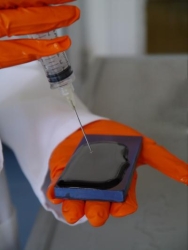
Image caption – A gel-coated titanium surface binds proteins that promote bone formation. Courtesy of Ida Berts.