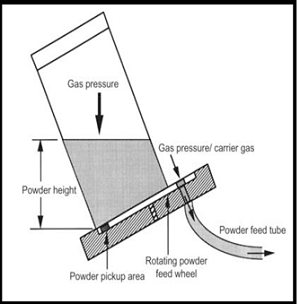
Volumetric powder feeders are based on a positive-displacement mechanism to deliver packets of powder. There are two volumetric mechanisms: one is screws of various sizes and the other is made up of wheels that are slotted, spoked, or drilled. As a screw turns or a wheel rotates within a bed of powder, the powder is displaced by the screw or picked up by the wheel and taken to the carburetor, where it is suspended or fluidized in the carrier gas delivered to the powder port in the gun.
Tampers sometimes assist the packing of non-free-flowing powders into the wheel slots or holes. Vibrators also help when powders do not flow well. Sometimes scalpers or scrapers scour excess powder from the tops of the slots/holes, so that a predetermined volume of material is delivered to the carburetor for each wheel revolution. In screw feeders, the end of the screw enters a tube, which serves the same function of controlling the volume per revolution of the screw, keeping excess powder from entering the carburetor.
In both volumetric feeder designs, powder enters the carrier gas stream by a positive pressure and, with gravity assist, moves the powder particles from the pickup area in the carburetor to the powder-feed hose leading to the gun. Feed rate is controlled by wheel or screw rotational speed. Manufacturers offer screws with different pitches or wheels with different slot/hole numbers and sizes for feeding powders over a range of feed rates. Feed rate is also affected to a lesser extent by gravity, volume of powder in the hopper, powder characteristics, and carrier gas flow. Figure 2 schematically shows a common volumetric feeder design.
This information is from ASM Handbooks Online, Vol. 5A: Thermal Spray Technology, Coating Structures, Properties, and Materials. To find this information (subscription required), click on the link below and scroll down to Figure 2.