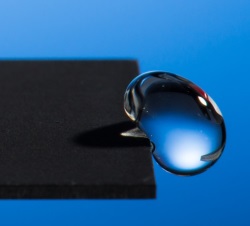
Scientists at the University of Rochester, N.Y., have reportedly transformed platinum, titanium, and brass into superhydrophobic materials with femtosecond laser pulses. Superhydrophobicity makes a surface rust-resistant, anti-icing, and anti-biofouling, all of which could help make such devices more robust and easier to maintain. The superhydrophobic surfaces can also clean themselves, since water droplets repelled from the surface carry away dust particles very efficiently.
This work builds on earlier research by the team in which they used a similar laser-patterning technique that turned metals black. Dr. Guo states that using this technique they can create multifunctional surfaces that are not only super-hydrophobic, but also highly absorbent optically.
“This is the first time that a multifunctional metal surface is created by lasers that is superhydrophobic, self-cleaning, and highly light absorptive,” said Chunlei Guo, a physicist at the Institute of Optics at the University of Rochester. He made the new surfaces with his colleague and fellow University of Rochester researcher Anatoliy Vorobyev. The researchers describe the laser-patterned surfaces in an article, “Multifunctional surfaces produced by femtosecond laser pulses.” It was published in the Journal of Applied Physics on January 20, 2015 (DOI: 10.1063/1.4905616). It can be accessed at: http://scitation.aip.org/content/aip/journal/jap/117/3/10.1063/1.4905616.
Dr. Guo says that one of the big advantages of his team’s process is that “the structures created by our laser on the metals are intrinsically part of the material surface.” That means they won’t rub off. And it is these patterns that make the metals repel water.
The team is now planning on focusing on increasing the speed of patterning the surfaces with the laser, as well as studying how to expand this technique to other materials such as semiconductors or dielectrics, opening up the possibility of water repellent electronics.