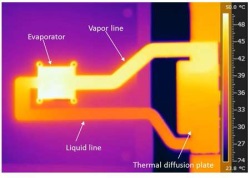
Fujitsu Laboratories, Japan, has reportedly developed the world’s first thin heat pipe designed for small electronic devices. It is a thin loop copper heat pipe less than one millimeter thick, based on technologies for stacking metal sheets. It is said to be capable of transferring approximately five times more heat than current thin heat pipes.
The evaporator contains a porous structure, with the numerous holes driving the fluid with capillary action. To achieve this action, engineers stacked together copper sheets 0.1 mm thick, to develop a structure containing minuscule pores. The pattern of holes etched into the sheets is such that the holes of each layer are slightly offset from the adjacent layers. When these sheets are stacked, capillary action causes the fluid to circulate.
In addition, by separating the vapor phase and liquid phase, there are two flows of the working fluid within the stacked structure, which enables efficient heat transfer. Furthermore, this technology can now be applied to mobile devices, because the liquid line that returns fluid to the evaporator operates on capillary action, enabling it to stably transfer heat regardless of orientation.
Because this loop heat pipe uses the heat from the heat source to power thermal transfer, without an external pump or other energy source, it does not increase the overall energy consumption.
This loop heat pipe uses copper sheets that are only 0.1 mm thick, with two surface sheets and four inner-layer sheets, for a total of six sheets. The previous, approximately 10 mm-thick evaporator of the loop heat pipe can now be reduced to 0.6 mm, enabling a heat-transfer device to be placed in compact mobile devices.
Compared to previous thin heat pipes and material of highly thermally conductive sheets, this new device allows for approximately five times greater heat transfer. The new technology will allow CPUs and other parts to function at low temperatures while preventing heat concentration within localized areas.