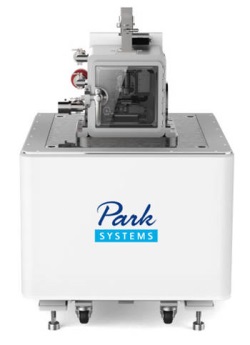
Park Systems, Santa Clara, Calif., introduces the NX-Hivac AFM system for semiconductor failure analysis. The high vacuum scanning spreading resistance microscopy (SSRM) of the system enables 2D carrier profiling of next-generation devices. It measures the high-resolution SSRM image under high vacuum conditions to minimize sample-tip damage. The system is said to be very sensitive and responsive to the current signal for its accurate measurement and repeatability.
The NX-Hivac is ideal for academic and industrial customers who are interested in failure analysis solutions in highly doped semiconductor processing, where more highly sophisticated failure analysis tools are now required.
Designed with the capability for multiple sample loading (up to 5), Park NX-Hivac is also able to measure a wide dynamic range of dopant concentration (7 decades). Other features include a fast signal response even at the range of insulator–metal, where the conductance is being changed dramatically. A significant advantage of NX-Hivac is that the high vacuum SSRM measurement shows much higher sensitivity and resolution than ambient conditions. This is due to the applied force between the tip and sample under ambient or a dry nitrogen condition, which is four times higher than in a vacuum. The low force required reduces the strain of thin films of target samples, giving a higher spatial resolution, resulting in longer tip life and increased productivity.
The NX-Hivac complete system includes Park’s unique design features, such as a closed-loop XY scanner for accurate zoom-in imaging, low noise ratio (0.30 Å even when vacuum pump is on), increased tip lifetime, and the reliability of guaranteed repeatability. Special features such as software control for automatic pumping and venting, motorized laser alignment, and high resolution axis-optics enhance the ease of use for the operator.