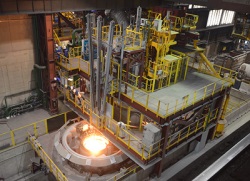
Ipsen, Cherry Valley, Ill., announces that its Global Development Team in Kleve, Germany, recently celebrated the first build and testing of the Argos heat treating system, in which low-pressure carburizing combined with 20-bar nitrogen quenching reportedly provides metallurgical properties never before seen in gas quenching systems. One industry visitor who witnessed the test run commented, “The Argos is likely the fastest inert-gas quench furnace in the world.”
This initial test was carried out on one of the most difficult to quench vacuum carburized components: layshafts for large gears. Until now, helium gas, which is both expensive and declining in availability, was required to fully transform parts with very high cross-sectional thicknesses.
Test outcomes showed that the shafts processed in the Argos system with 20-bar nitrogen quenching achieved higher surface hardness and core hardness values than shafts processed in the existing vacuum heat-treating furnaces with 20-bar helium quenching.
The Argos system offers several additional benefits:
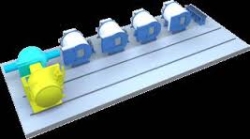
Flexible installation with a selectable number of carburizing, nitriding, subzero, and high-vacuum process chambers with a nitrogen gas and/or oil quench module;
Excellent temperature uniformity during heating and cooling;
Minimal and controllable distortion due to temperature homogeneity throughout the entire load, and the reversible gas flow during cooling;
Extremely high gas velocity and volume due to Ipsen’s unique cooling system design.
Overall, the Argos furnace line represents a significant milestone in the growing trend to operate low-pressure carburizing (LPC) lines in combination with inert gas quenching.