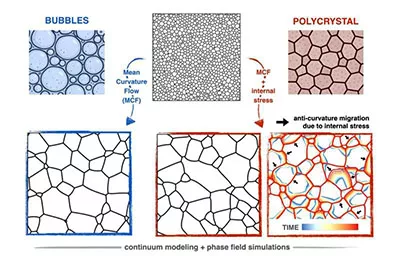

An international team of scientists headed by Prof. Marco Salvalaglio from TUD–Dresden University of Technology in Germany discovered that internal stresses—not just interface energy—play a key role in shaping the microstructure of crystalline materials. These findings challenge classical theories and may improve how we design materials for engineering and technology.
Using advanced computer simulations and theoretical modeling, Salvalaglio and his team demonstrate that shear deformations and internal mechanical stresses—emerging as grain boundaries move—play a crucial role in how microstructures evolve. Such a mechanism, known as “shear coupling,” can strongly influence the shape and behavior of grains, making their growth deviate from classical theories.
This discovery helps explain why real polycrystals often behave differently than predicted and could lead to better ways of designing materials for specific uses, from stronger metals to more efficient electronics. It also further highlights what sets crystalline materials apart from other systems like foams or emulsions: they are capable of sustaining deformations.
“Until now, our work has primarily focused on stresses generated by interface motion in single-component polycrystalline systems. With this groundwork in place, the next step is to address the interplay with other mechanisms, such as plastic relaxation within grains, and to investigate analogous phenomena in multicomponent materials,” states Salvalaglio.
The team’s research has been published in the Proceedings of the National Academy of Sciences.
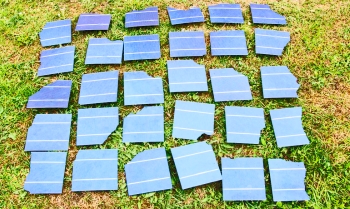
Image – These phase-field simulations show the microstructure evolution in a system of ~1000 grains. Courtesy of Marco Salvalaglio.
************
For more information:
Dresden University of Technology