The National Institute of Standards and Technology (NIST), the National Institutes of Health (NIH), and Canada’s University of Waterloo have developed an innovative way to focus beams of neutrons allowing scientists to probe the innards of opaque objects at a size range they were blind to previously. The new method allows for the interior examination of objects from meteorites to cutting-edge manufactured materials without damaging them.
The method, published in Physical Review Letters, could convert what historically has been a support tool for neutron science into a full-fledged scanning technique that could reveal details ranging in size from 1 nanometer up to 10 micrometers within larger objects. The approach provides neutron interferometry with what are essentially its first movable “lenses” capable of zooming in and out on details in this size range—a range that has been difficult to probe, even with other neutron scanning methods.
These “lenses” are silicon wafers acting as diffraction gratings, which take advantage of neutrons’ wavelike properties. The gratings split and redirect a neutron beam so that the waves bounce off an object’s edges and then collide with one another, creating a visible moiré interference pattern representative of the object that is easy for experts to interpret.
According to NIST’s Michael Huber, the approach could make neutron interferometry into one of the best exploratory tools in a material scientist’s kit.
“We can look at structure on lots of different levels and at different scales,” said Huber, a physicist with NIST’s Physical Measurement Laboratory who conducts experiments at the NIST Center for Neutron Research (NCNR). “It could complement other scanning techniques because its resolution is so good. It has a dramatic ability to focus, and we aren’t limited to looking at thin slices of material as with other methods—we can easily look inside a thick chunk of rock.”
Neutron interferometry is the best way to obtain a substance’s index of refraction, a number indicating how much it will bend a beam from the direction it is traveling. Unfortunately, crystals that are good enough for interferometry also block out most of the neutrons that strike them, meaning it takes a long time for a beam to send enough neutrons past a sample to get an accurate index of refraction. Other tasks would take far longer.
The new approach sidesteps these problems by using a trio of thin silicon gratings to focus the neutrons instead of a single costly crystal. Under a microscope, the flat surface of each grating looks like a comb with narrow, closely spaced teeth. Not only do the gratings allow the entire neutron beam to pass through them—rather than the trickle of neutrons that get through the crystal—they have the pivotal advantage of being movable.
Huber said only one thing stands in the way of their interferometer becoming a great tool for industry: They need a set of apertures of different widths the neutron beam will pass through before it hits the interferometer. Right now, they only have a single aperture at their disposal, and it limits their vision.
************
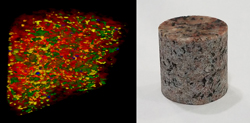
Image – The neutron interferometer can scan the interior of thick objects, such as this chunk of granite, providing enough detail to show the four types of rock that are mixed within it. Courtesy of Huber & Hanacek/NIST.
More information: