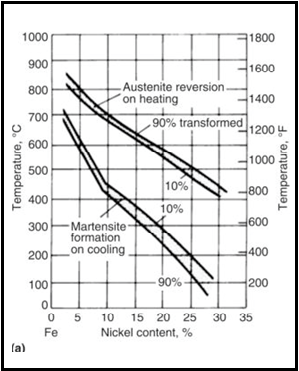
The term marage was coined based on the age hardening of the martensitic structure. Age hardening of martensite, or maraging, depends on the occurrence of a thermal hysteresis of phase transformations, whereby the reversion of martensite to austenite during reheating occurs at a higher temperature range than the temperature range for martensite formation during cooling.
During the aging of the martensitic structure, the basic objective is to form a uniform distribution of fine intermetallic precipitates, which serve to strengthen the martensitic matrix.
Another basic objective during the aging of maraging steels is to minimize or eliminate the reversion of metastable martensite into austenite and ferrite. Fortunately, the kinetics of the precipitation reactions that cause hardening of iron-nickel maraging steels are such that considerable age hardening—that is, approximately 20 HRC points (1035 MPa, or 150 ksi)—occurs before the onset of the reversion reactions that produce austenite and ferrite. The iron-nickel maraging steels also exhibit a thermal hysteresis in phase transformations that prevents or minimizes martensite-to-austenite reversion during aging heat treatment. This thermal hysteresis and phase behavior are illustrated in the two phase diagrams of Fig. 2, which depict the iron-rich end of the iron-nickel binary system. Figure 2(a) is the metastable diagram plotting the austenite-to-martensite transformation upon cooling and the martensite-to-austenite reversion upon heating. Figure 2(b) is the equilibrium diagram showing that at higher nickel contents the equilibrium phases at low temperatures are austenite and ferrite.
Volume 4D, Heat Treating of Irons and Steels -> Heat Treated High-Alloy Steels -> Heat Treating of Maraging Steels