ADI is a unique cast iron material with tensile properties attributable to γH with a fine dispersion of ferrite. Austempering is accomplished by heating the casting to a temperature in the austenite-phase range (usually 815 to 925 °C, or 1500 to 1700 °F), and holding for the time required to saturate the austenite with carbon. The cast ironis then cooled to a temperature above the Ms temperature at a rate sufficient to avoid the formation of pearlite or other mixed structures. In the final step, the material is held at that austempering temperature for the time required to produce the optimal structure of acicular ferrite and carbon-enriched austenite.
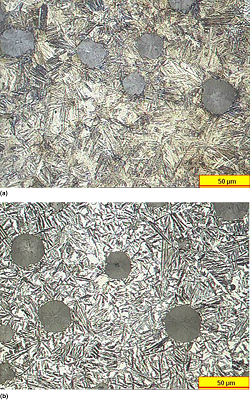
The properties of ADI can be varied by changing the austempering temperature. A lower transformation temperature (260°C, or 500°F) produces a fine, high-strength, wear-resistant structure, as shown in the micrograph (Fig. 6a).
A higher transformation temperature (370 °C, or 700 °F) results in a coarser structure (Fig. 6b) that exhibits high fatigue strength and good ductility. The various grades of ADI have been quantified in ASTM A897/897M-06 (reapproved 2011).