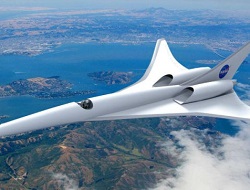
Researchers from the University of Manchester in England, and Central South University in China, announce that they have developed a carbide coating in which powders of zirconium, boron, and titanium are infused into a carbon composite, producing a coating that can withstand the high temperatures of aircraft structures flying at over five times the speed of sound.
The new ceramic was made by the Powder Metallurgy Institute at Central South University and evaluated at Manchester. It’s produced by means of Reactive Melt Infiltration (RMI), which involves the penetration of elements including zirconium, boron, and titanium into a matrix made of a composite of different types of carbon. Normally, the high operating temperatures of ceramics drive off protective elements and leave the remaining ceramic vulnerable to degradation, but RMI makes the ceramic much harder and extremely resistant to surface degradation at hypersonic temperatures.
“Current candidate UHTCs for use in extreme environments are limited and it is worthwhile exploring the potential of new single-phase ceramics in terms of reduced evaporation and better oxidation resistance,” says Professor Ping Xiao, Professor of Materials Science at Manchester. “In addition, it has been shown that introducing such ceramics into carbon fiber-reinforced carbon matrix composites may be an effective way of improving thermal-shock resistance.”